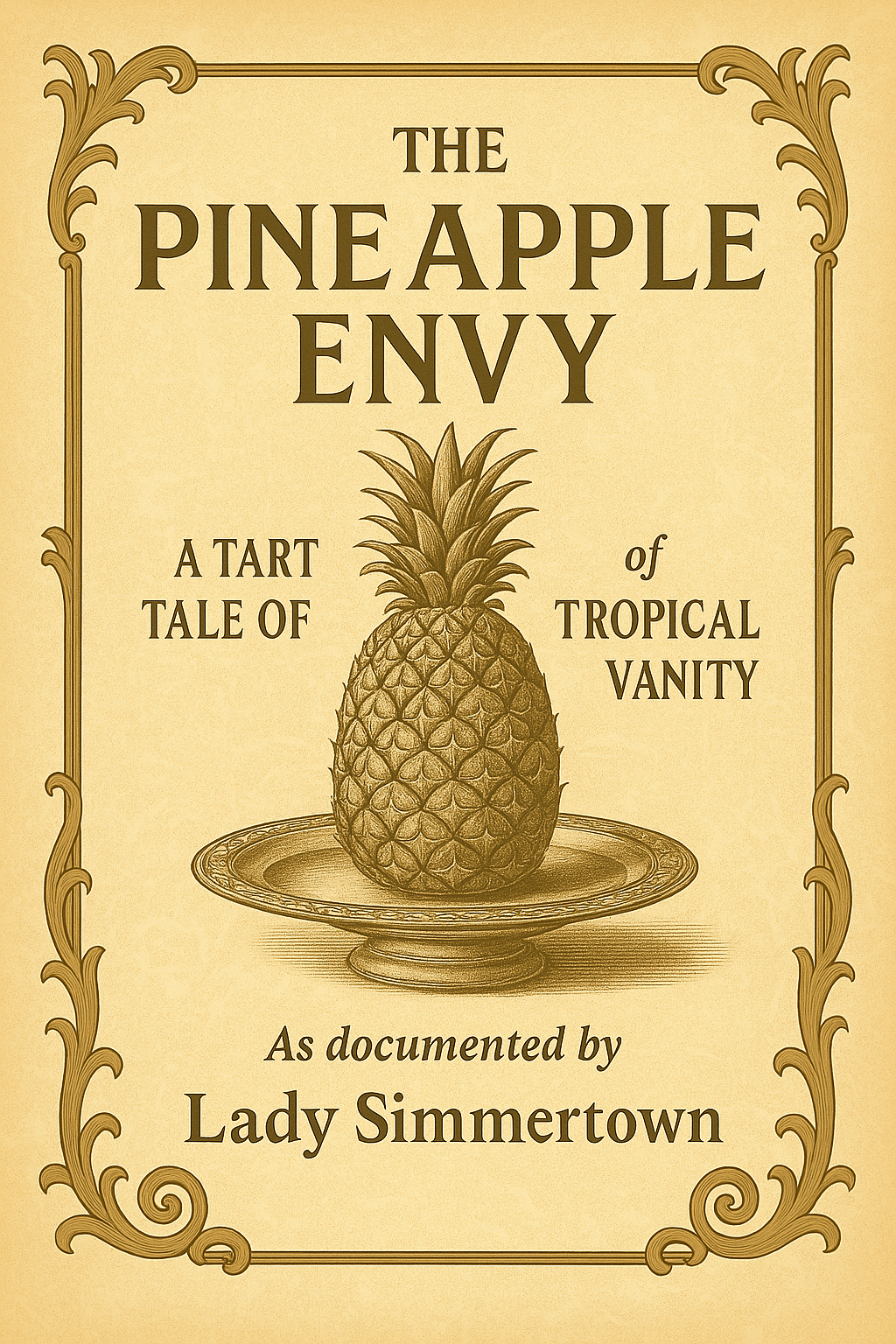
As documented (with considerable side-eye) by Lady Simmertown
Dearest Reader,
Of all the fruits to have ever graced a linen-draped table, none has caused more envy, deception, and outright moral decay than the pineapple.
Yes, the pineapple.
That absurdly adorned tropical bauble with the crown of a king and the manners of a mistress.
In our most refined circles, one could hardly cough in summer without being reminded, loudly, and with feigned modesty, that so-and-so had acquired one. Acquired! As if it were a minor feat and not a full-blown maritime campaign.
Imported Indulgence & Ice-Box Imperialism
Plucked from the steaming bosom of the Caribbean and shoved into chests of ice, which melted far faster than the egos involved, the pineapple journeyed across oceans, its every wobble accompanied by prayers and profit. Upon arrival, it was not sliced, not served, not shared.
No, darling. It was displayed.
A single fruit perched upon silver, as if the Duchess of Devonshire herself had laid an egg.
To possess one was to declare, without speaking:
“I am wealth incarnate. I am colonial elegance distilled. And I don’t need to eat my riches to prove them.”
Which, frankly, made it all the more suspicious.
The Rental Debacle
Now brace yourself, for the tale turns deliciously shameful.
Those unable to purchase a pineapple outright (how tragic) rented one.
By the hour.
Yes, one could borrow a fruit to dazzle their guests, provided, of course, they returned it intact.
The pineapple was thus paraded from parlour to parlour, handled like a duchess’s virtue: admired from a distance, guarded fiercely, and passed around more than one might publicly admit.
I have it on good authority that one particularly photogenic specimen made no fewer than nine appearances during the summer of 1789, under aliases such as “Lady Aurelia’s Garden Gift” and “My Cousin’s West Indies Shipment.”
No one questioned it. They were too busy swooning.
Of Lies, Rot, and Wooden Impostors
As with all prized objects, theft was inevitable.
One ambitious hostess, lacking both morals and melons, painted a wooden pineapple and passed it off at a garden fête. She nearly succeeded, until an inquisitive suitor leaned in and uttered the damning words:
“Why does it smell of varnish?”
Her invitations promptly dried up. As did her reputation.
Others, in even greater denial, let their pineapples rot on the mantel rather than part with them. Mold, it seemed, was preferable to modesty.
To eat the pineapple was to admit it had served its social purpose. To let it decay into ooze while guests pretended not to notice? Now that, dear reader, was fashion.
Empire in a Fruit Bowl
Naturally, beneath all this ornamental excess lay the bitter pulp of empire. These fruits were not plucked by cherubs. They were cultivated by enslaved hands, harvested on stolen land, and transported on the backs of misery, all so Lady Featherstone could casually mention hers was “a bit too ripe.”
And, true to imperial form, when faced with injustice, the solution was not reform… but dessert.
Preferably something iced and French.
A Modern Tragedy
Now? Pineapples are everywhere. In smoothies. On doormats. On pizza, heaven help us.
Their mystique has curdled. Their reign has rotted.
And yet, I confess, I still look upon them with fondness.
Not for the fruit itself, but for the sheer, unapologetic nonsense it inspired.
Long live vanity, I say. And long live the pineapple.
Yours in tropical decadence,
~ Lady Simmertown


 Butter, Ink & Indiscretion
Leave a comment