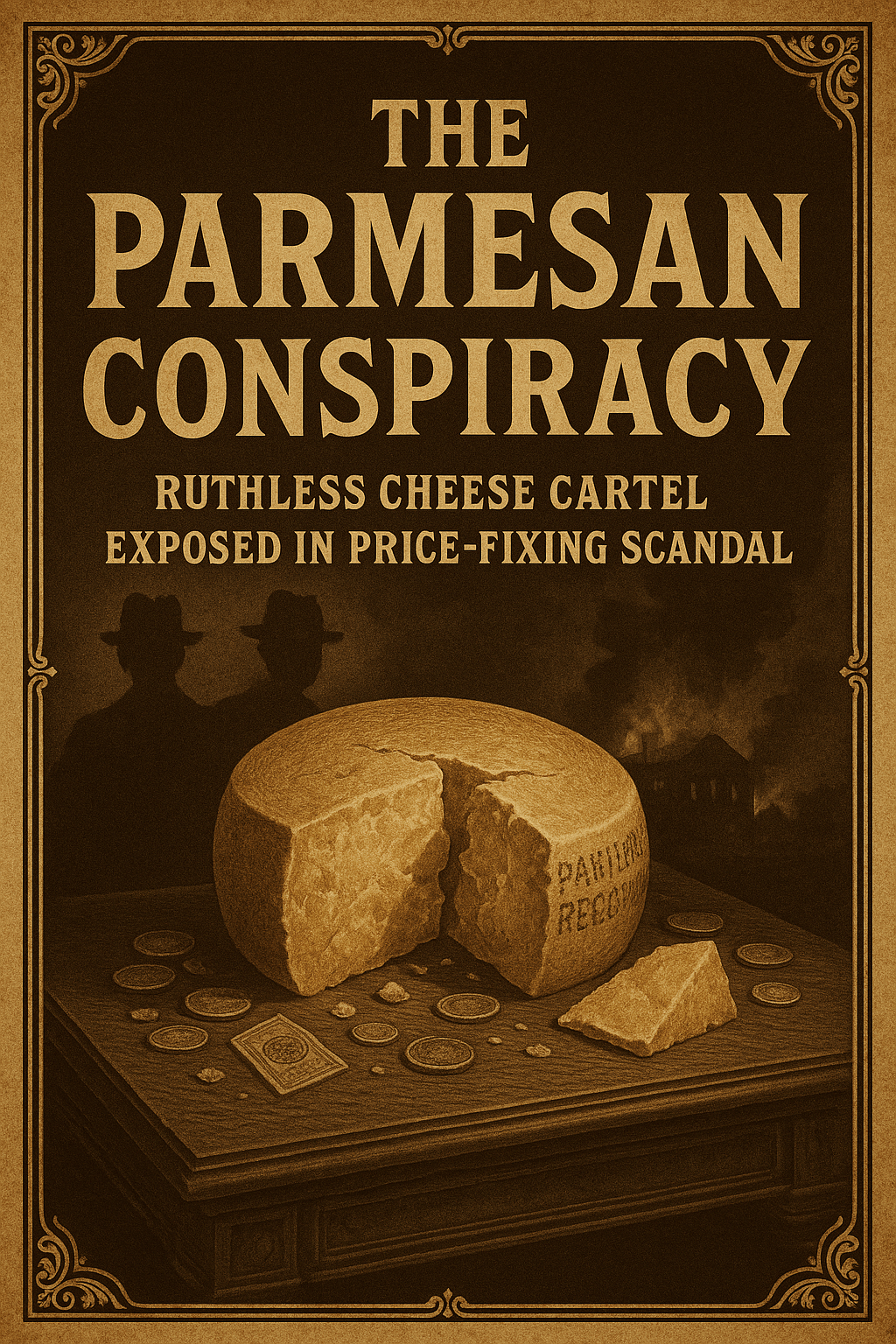
A True Food Crime from the Desk of Lady Simmertown
Dear Readers,
Let us cast our eyes not upon the rolling hills of Tuscany nor the lavender fields of Provence today, but toward the pungent, perilous heart of Italy’s dairy dominion: Emilia-Romagna. For nestled amongst its golden pastures and oak-braced aging rooms lies a tale so riddled with rot and regality, it curdles the soul.
Yes, dearest society, this is not merely about cheese.
This is about power, greed, and a dairy dynasty nearly dethroned by crime.
Gather close, for today we descend into the underworld of Parmigiano Reggiano, where every wheel was once a throne, and every bite, a bribe.
The Crown Jewel of Italy’s Culinary Court
To the uninitiated, Parmigiano Reggiano may appear simply as a block of hard cheese. But to Italians, it is something else entirely, a birthright, a legacy, a weapon of class and culture. This is not cheddar to be grated at whim or sliced into school lunches. This is Parmigiano Reggiano, a cheese with credentials, its pedigree sealed beneath the iron will of the European Union’s Protected Designation of Origin.
By law, it must be crafted in a sacred circle of five provinces: Parma, Reggio Emilia, Modena, and select corners of Bologna and Mantua. It must age no fewer than twelve noble months. And most importantly, it must wear the crown, a dotted rind brand bestowed only by the Consorzio del Formaggio Parmigiano Reggiano, the royal court of curd.
But behind these velvet-curtained inspections and choir-hummed aging chambers, a darker mold was spreading. The cheese that once ruled the table was being ruled in turn, by deceit, manipulation, and corruption.
Wheels of Wealth: When Dairy Became Currency
Every wheel of Parmigiano Reggiano is a small fortune incarnate, often worth over a thousand euros. With millions of wheels produced each year, the cheese quickly transcended its culinary origins and entered the realm of finance.
Banks, ever attuned to the scent of profit, began accepting cheese as collateral for loans. It was no metaphor. In the cellars of Credito Emiliano, entire vaults were filled not with gold bars, but with wheels of butterfat and salt. Armed guards patrolled rows of dairy. Parmigiano, once a peasant’s delight and a prince’s table treasure, now became a financial instrument.
But what happens when cheese becomes a bearer bond? When its value is not in taste, but in speculation? When the rind hides not just aging curds, but deceit?
The Great Cheese Loan Scandal: 2008 to 2010
From the shadows of the aging cellars came not only curds, but corruption, perfumed in Parmesan and cloaked in decay.
Between 2008 and 2010, Italian authorities uncovered a scheme as rich in scandal as it was in stench. Cheese producers, in quiet collusion with unscrupulous warehouse managers and cooperative bank officials, began stacking loans atop the same wheels. Some of these wheels had failed quality inspections. Others were long expired. A few were reportedly repurposed, their flaws scrubbed away, their stamps rebranded. Some accounts even whispered of wheels that were not cheese at all, just painted shells, masquerading as wealth.
When the warehouses were finally raided, what they found was a grotesque parody of luxury: rotting wheels, forged documents, fraudulent loans, and a kingdom of trust curdled to its core.
But this, dear reader, was merely the appetizer.
Enter the Agromafia: Where the Cosa Nostra Met the Cow
As the smoke cleared from the vaults, investigators uncovered something more sinister still.
The cheese was not merely spoiled, it had been touched by the hand of the Mafia.
Italy’s Anti-Mafia Investigative Directorate revealed that organized crime had infiltrated the food chain. These were not cartoonish gangsters in pinstripe suits. These were modern men in business attire, manipulating dairy, wine, and olive oil with the same ruthlessness once reserved for narcotics and firearms.
They called it the Agromafia. And it had found paradise in the sanctity of the Italian dinner table.
In Emilia-Romagna, dairy farmers were pressured into illegal price-fixing schemes. Inspectors were offered bribes. Whistleblowers found themselves stalked. And when coercion failed, there was always fire. Entire warehouses were reduced to ash, arson, it seemed, was simply another form of negotiation.
A Consortium or a Cartel?
And where, you ask, was the noble Consorzio Parmigiano Reggiano during all this?
Ah, there lies the most delicate question of all.
The Consortium, established to protect the sanctity and quality of Parmigiano Reggiano, insisted it was above reproach. But murmurs echoed through the valleys. Some smaller producers began to allege that the Consortium itself had grown too powerful, too selective in who it certified, too opaque in how it controlled the market, too willing to play kingmaker.
Those not seated at the long table, it was said, were left in the cold.
The line between quality assurance and monopolistic stronghold had blurred.
And for many, the only way to survive was to submit.
A Global Grate: The Counterfeit Crisis
Yet the saga does not end in Italy’s rolling pastures. No, the desecration spread far beyond her borders.
Across the Atlantic, Americans were grating tubs of “Parmesan” over their fettuccine with blind devotion. But what lay inside those tubs was no kingly cheese. In 2016, the Castle Cheese Inc. scandal revealed that many domestic Parmesan products contained no Parmigiano Reggiano whatsoever. Instead, they were padded with cellulose, cheddar, and filler, cheap imposters cloaked in noble names.
According to the Consorzio, nearly ninety percent of all “Parmesan” sold globally is counterfeit. A cheese once crafted by monks and aged beneath stone now finds itself stuffed into plastic tubs, stripped of dignity, reduced to a powdered fraud.
A Wheel Divided: What Remains
Some arrests were made. Warehouse owners and bank officers were charged. The Consortium launched new tracking systems to better trace each wheel’s journey. The European Union made loud gestures toward cracking down on international mislabeling.
But rot, dear reader, is never fully cleansed with a single scraping.
The Agromafia continues to flourish in the shadows. Small cheesemakers remain at the mercy of distant authorities. And Parmigiano Reggiano, once the untouchable jewel of Italy’s culinary crown, walks a knife’s edge between reverence and ruin.
The Final Grating
So the next time a waiter approaches with a grater in hand and a knowing smile, do not simply nod. Look to the rind. Think of the vaults. And ask yourself:
Was this wheel aged in a cave, or cooked in a crime?
With Affection and Alarm,
~ Lady Simmertown
For the Skeptics and the Scholars
Should your curiosity demand receipts, as all good minds do, below lies a selection of trusted sources that informed this investigation into dairy deception, financial rot, and the parmesan underworld:
- Coldiretti (Italian Farmers’ Union). Reports on the Agromafia and organized crime’s infiltration of the agricultural sector.
- Italy’s DIA (Direzione Investigativa Antimafia). Official documentation and annual reports detailing mafia activity in the food supply chain.
- Credito Emiliano Bank. Known for accepting Parmigiano Reggiano wheels as collateral, with public statements and coverage in financial news outlets.
- The Guardian (2014). “Mafia is muscling in on Italy’s food industry.”
https://www.theguardian.com/world/2014/nov/11/mafia-italy-food-industry-infiltration - Bloomberg (2016). “The Parmesan Cheese You Sprinkle on Your Penne Could Be Wood.”
https://www.bloomberg.com/news/articles/2016-02-16/the-parmesan-cheese-you-sprinkle-on-your-penne-could-be-wood - U.S. Food and Drug Administration. Reports and legal actions regarding Castle Cheese Inc. and mislabeling of Parmesan products.
- European Commission. Official PDO guidelines and regulatory framework for Parmigiano Reggiano.
https://ec.europa.eu/info/food-farming-fisheries/food-safety-and-quality/certification/quality-labels/geographical-indications-register/ - Consorzio del Formaggio Parmigiano Reggiano. Official site with regulations, history, and efforts to combat fraud.
https://www.parmigianoreggiano.com


 Butter, Ink & Indiscretion
Leave a comment