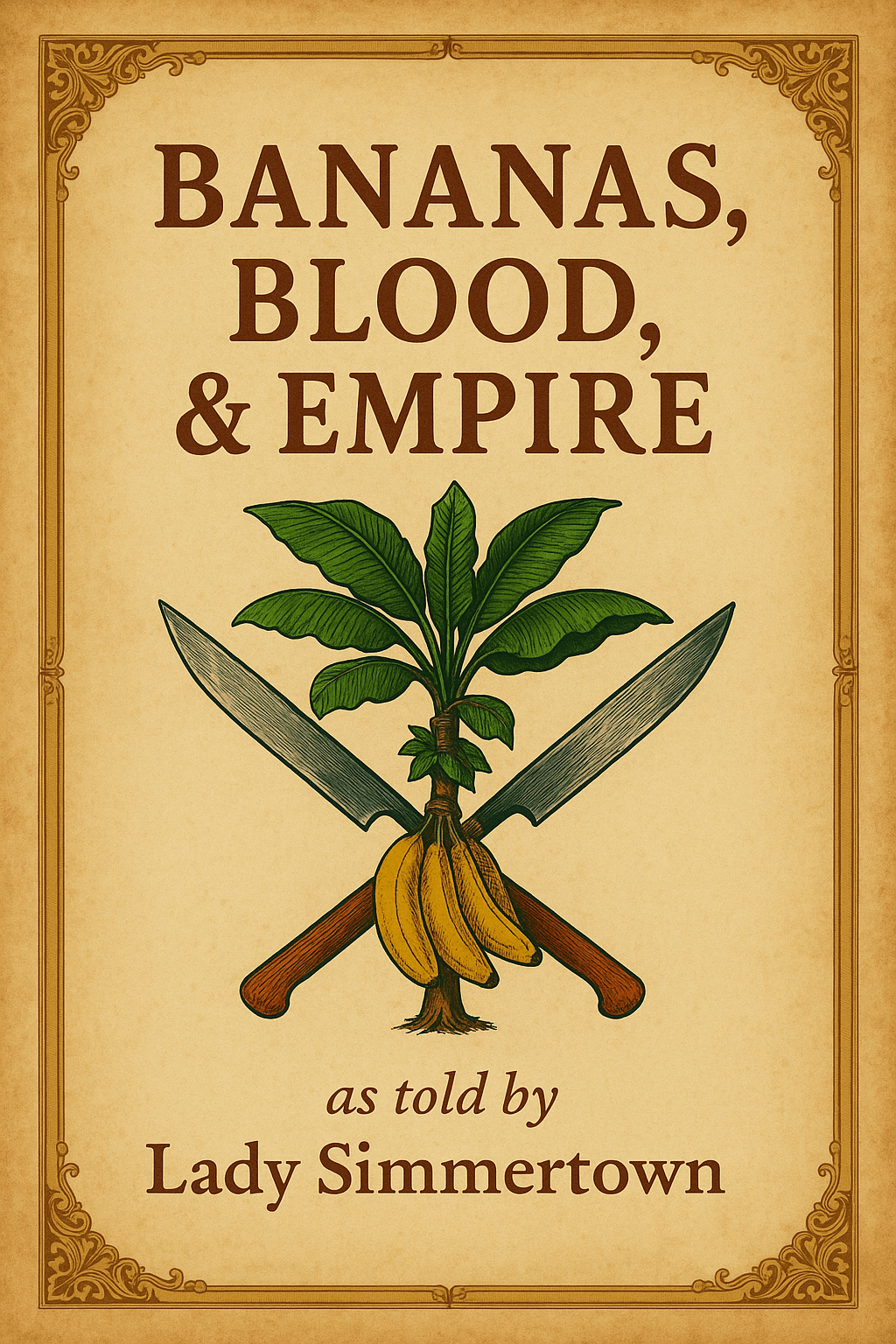
My dearest readers,
If you believed the humble banana to be an innocent fruit, as harmless as a sun-kissed morning in the tropics, allow me to shatter that illusion. Behind its jaunty yellow peel lurks a saga of empire, blood, and betrayal, one so grotesque it makes the scandals of polite society look like nursery gossip. Today, we sharpen our quills and turn them toward none other than the Chiquita banana company, once known as the United Fruit Company, a name that drips with as much venom as it does nostalgia.
The Tyrant in a Fruit Hat
Founded in 1899, United Fruit did not simply sell bananas; it bent entire nations to its will. With sprawling plantations across Central America, they were less a company and more an empire, with railroads, ports, and entire governments wrapped tightly around their sticky fingers. It was they who gave birth to the term “banana republic”, a phrase that began as a whisper of political mockery but soon became a chilling truth.
They controlled the land, the wages, and, indeed, the very lives of the people who plucked their golden fruit. Payment was often in company scrip, vouchers that could be spent only in company stores, an economic noose disguised as a paycheck. And when the workers finally dared to raise their voices in protest, what followed was not negotiation, but carnage.
The Banana Massacre of 1928
The scene was Colombia, in the dusty town of Ciénaga. It was December, the season of festivity and feasting, but for the United Fruit workers, it was the season of revolt. Thousands of laborers demanded something scandalously radical: fair pay, humane working conditions, and the right not to be treated as expendable. United Fruit, predictably, screamed “communism!” and scurried to its most powerful ally, the U.S. government.
On the night of December 6, 1928, the Colombian army, under pressure from both the company and American officials, opened fire on the striking workers. It is said that the plaza ran red with blood. While official records claimed a few dozen deaths, whispers and witness accounts tell of hundreds, perhaps over a thousand, slain. The bodies? Many were loaded onto trains, dumped into the sea, or buried in unmarked graves, as if their existence could be erased like an inconvenient stain.
This atrocity, this “Banana Massacre,” as history now calls it, would later be immortalized by Gabriel García Márquez in One Hundred Years of Solitude. Yet no novel could match the grotesque reality of fruit grown in soil watered with blood.
A Rotten Legacy
Did the horrors end there? Oh, my loves, of course not. Like all seasoned villains, the company learned to rebrand, changing its name from United Fruit to the cheerfully innocent “Chiquita.” But a new name cannot bleach the stains of old sins, especially when new scandals keep piling on like overripe bananas.
In the 1990s and early 2000s, Chiquita was caught funnelling millions of dollars to violent Colombian paramilitary groups, including the Autodefensas Unidas de Colombia (AUC), a right-wing death squad network infamous for massacres, extortion, and terror. These groups were not hired for mere “security” as Chiquita claimed, they were clearing land of unions, farmers, and anyone who dared oppose the company’s stranglehold over banana-growing regions. It was blood money, disguised as “protection payments.”
When U.S. authorities discovered these bribes, Chiquita admitted to paying over $1.7 million to the AUC between 1997 and 2004, even though the group had been officially designated a terrorist organization by the U.S. State Department in 2001. Rather than a noble confession, this admission came only after intense investigations and a looming criminal case. The company paid a $25 million fine in 2007, pocket change compared to the profits they reaped, yet no executive was ever imprisoned.
Worse still, survivors and families of victims have long alleged that Chiquita’s payments directly funded attacks on civilians and union leaders. In recent years, lawsuits have surfaced in U.S. courts from Colombians seeking justice for these atrocities, claiming that Chiquita’s hands are soaked in more blood than they will ever admit.
The Bitter Truth
Bananas, my darlings, may seem like the most innocent of fruits, a breakfast adornment, a smoothie ingredient, a lunchbox favorite. But behind their sunny smile lies a history steeped in colonial exploitation, corruption, and murder. Every bite, if you dare to look closely, carries the faint taste of empire.
So the next time you peel back that cheerful yellow skin, remember that you are holding not just a fruit, but a relic of greed and bloodshed. A sweet deception, born of fields that once echoed with the cries of the forgotten.
Yours,
Lady Simmertown
For the Skeptics & the Scholars
Bucheli, M. (2005). Bananas and Business: The United Fruit Company in Colombia, 1899–2000. New York University Press.
McCann, T. P. (1976). An American Company: The Tragedy of United Fruit. Crown Publishers.
LeGrand, C. (1986). Frontier Expansion and Peasant Protest in Colombia, 1850–1936. University of New Mexico Press.
García Márquez, G. (1970). One Hundred Years of Solitude. Harper & Row (fictionalized account of the massacre).
Taussig, M. (1987). Shamanism, Colonialism, and the Wild Man: A Study in Terror and Healing. University of Chicago Press.
National Security Archive. (2007). “Chiquita Papers: Documents Detail Support for Colombian Paramilitaries.” [declassified report].
BBC News. (2007). “Chiquita fined $25m for paying Colombia paramilitaries.”


 Butter, Ink & Indiscretion
Leave a comment