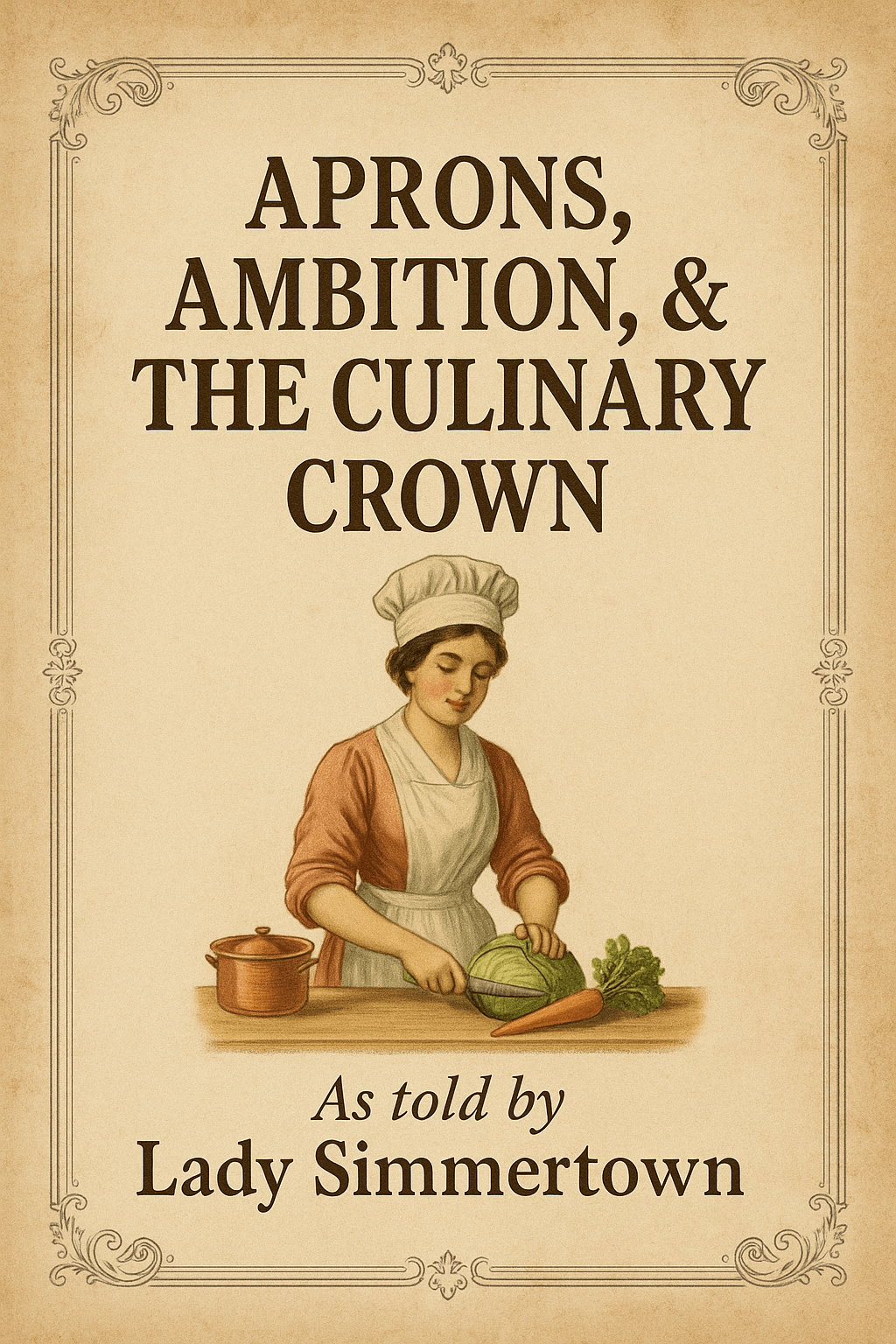
Dearest Readers,
Why is it, one wonders, that the great public kitchens of history have so often rung with the voices of men, while the talents of the fairer sex were confined to the hearth, the market stall, or the genteel tea table? This is no idle curiosity, for the imbalance has persisted across centuries, continents, and cuisines.
The answer is neither singular nor sensational, but rather a stew of circumstance, part physical demand, part tradition, part the simple logistics of a life divided between home and profession. And yet, while their names may appear less often in the rolls of grand hotels or Michelin guides, women have always shaped the very flavors those kitchens sought to perfect.
Let us, then, trace the course from the bread ovens of antiquity to the gleaming brigades of the modern restaurant, and see precisely how such a curious arrangement came to be.
In the Days of Antiquity: Bread, Beer, and the Birth of Taste (c. 3000 BCE – 476 CE)
In ancient Egypt (c. 3000 BCE), women stood at the center of daily sustenance, grinding grain into flour, shaping loaves for communal ovens, and brewing beer in vast clay jars. These were not side tasks but cornerstones of survival. Greek society, by the 5th century BCE, relied on women to prepare the home table, while male cooks (mageiroi) oversaw the great feasts of the symposium. Yet in Athens’ bustling agora, female vendors sold honeyed cakes, figs, and prepared meals to travelers and laborers alike.
Rome, at its height (1st century BCE – 5th century CE), placed culinary prestige in the hands of male coqui, often enslaved and trained to produce lavish banquets. Still, women worked in preservation, cheesemaking, and confectionery, crafting perfumed sweets for festivals such as Saturnalia. Though unnamed in most records, their labor flavored every layer of society.
Medieval & Renaissance Whispers (c. 500 – 1600)
Following the fall of Rome, the great urban kitchens gave way to the kitchens of castles, monasteries, and manor houses. In England by the 12th century, women brewed ale as alewives, often supporting entire households with the income. So vital was this trade that taxes on ale became a reliable source of royal revenue.
The rise of the guild system in the 13th century formalized professions such as baking, brewing, and roasting. Membership, requiring long apprenticeships and strict regulation, was almost entirely male. Still, women thrived outside guild control: running market stalls in Florence, selling hot pies in London’s Cheapside, or managing the kitchens of noble estates. The Renaissance saw culinary refinement cross borders, most famously when Catherine de’ Medici married Henry II of France in 1533, bringing Italian techniques to Parisian courts.
The 1600s–1700s: Ink-Stained Aprons and Sugarcraft Secrets
In 1661, Hannah Woolley broke new ground in England by publishing The Ladies Directory, the first known cookbook under a woman’s own name. Her works, reprinted for decades, guided housekeepers through menus, etiquette, and remedies.
In France, convent kitchens became centers of delicate artistry. By the 1680s, Carmelite and Ursuline nuns were producing candied orange peels, almond pastes, and sugar sculptures, sold to support their orders. Public kitchens, however, demanded a stamina and scale that kept them male-dominated: 14-hour days, copper stockpots weighing over 100 pounds, and service for hundreds at a time.
The 1800s: Command of the Hearth and Purse
The 19th century ushered in an age of culinary authorship. Eliza Acton’s Modern Cookery for Private Families (1845) introduced precise measurements and a logical recipe format. Isabella Beeton’s Book of Household Management (1861) compiled over 900 recipes with detailed guidance on running a respectable household.
In America, waves of immigration reshaped the dining table. Italian bakers brought crusty loaves to New York, Irish women ran boardinghouse kitchens, and German butchers’ wives prepared sausages for sale in public markets. Hotel kitchens, like New York’s famed Delmonico’s, remained the province of men, but bakeries, tea rooms, and catering companies flourished under female ownership.
Late 1800s – Early 1900s: The Mères Take the Stage
In Lyon, the Mères Lyonnaises became culinary royalty. Many had begun as domestic cooks for wealthy families; upon striking out on their own, they served dishes such as quenelles de brochet in crayfish sauce to an eager middle class. Eugénie Brazier, born in 1895, trained under Mère Fillioux and went on to earn six Michelin stars by 1933, three each for her two restaurants, a feat unmatched for decades.
In the United States, Fannie Farmer, principal of the Boston Cooking School, published The Boston Cooking-School Cook Book in 1896, standardizing American cooking measurements. Across the country, women kept frontier towns fed in boardinghouses and railroad hotels, often cooking three meals a day for dozens without the luxury of hired help.
Mid–Late 20th Century: Lights, Cameras, Cook!
Television transformed cooking from a private act to a public performance. Julia Child’s The French Chef debuted in 1963, teaching Americans the secrets of French cuisine. In 1971, Alice Waters opened Chez Panisse in Berkeley, pioneering the farm-to-table movement long before it became a buzzword.
By the 1980s, women were entering culinary schools in greater numbers, yet statistics showed they made up only 20–22% of chefs and head cooks in the U.S. The Michelin world still named few female stars, though many women dominated pastry, where artistry and precision were prized over brute force.
The 21st Century: A Measured Reality
Overall U.S. Chefs — 25% women, 75% men.
Executive Chefs (U.S.) — 23% women, 77% men.
Luxury Hotels (Global) — 1.5% women.
Michelin-starred Head Chefs (Global) — 6% women.
Top-100 Restaurants (World) — 6.7% women.
Pastry Chefs (U.S.) — 64% women, 36% men.
Culinary Schools — 50–60% women, yet far fewer in the highest ranks.
Why the Numbers Remain Uneven
The professional kitchen has long been a proving ground of stamina: heaving stockpots, hauling sides of meat, standing in sweltering heat for fourteen hours. Historically, apprenticeships required relocation, living in cramped quarters above the kitchen, and years of service before advancement, conditions more accessible to young men than women in most societies.
Beyond the physical demands, the hours were unpredictable, the work seasonal, and the career path unstable. Many women who did pursue cookery gravitated toward independent ventures, patisseries, tea rooms, catering companies, where they could exercise skill without the regimented, militaristic structure of haute cuisine brigades.
Even now, culinary schools often enroll more women than men, yet fewer choose the relentless pace of fine dining. Instead, they reign in spaces where creativity is unconstrained, schedules are humane, and their names, at last, appear proudly on the menu.
A Final Word from the Lady’s Table
So there it is, my dear readers, not a tale spun from ideology, but the unvarnished ledger of the kitchen itself. Through centuries, the hearth and the range have demanded different coin: one paid in patience and management, the other in muscle and unrelenting endurance.
That fewer women have claimed the latter is not proof of conspiracy, but of choice, circumstance, and the merciless nature of the craft. And yet, whether in palace kitchens, modest bakeries, or the whispered pages of cookery books, the fairer sex has flavored the world beyond measure.
May we judge them not by the clang of the copper pot, but by the legacy they have left upon the tongue.
Yours in scandal and sauce,
Lady Simmertown
For the Skeptics & the Scholars
To those who demand that every assertion be garnished with proof, I offer this final course, a collection of sources, figures, and writings from which the preceding narrative has been most liberally seasoned. Consult them as you please; whether you arrive at the same conclusions or stir the pot in dissent, you will at least be assured the broth is made from honest stock.
- U.S. Bureau of Labor Statistics, Occupational Employment and Wages (2023) — data on chefs and head cooks by gender.
- Zippia.com, Chef Demographics and Statistics in the U.S. (2023).
- Les Mères Lyonnaises: The Women Who Founded Lyon’s Culinary Fame — Musée Gadagne archives, Lyon, France.
- Acton, Eliza. Modern Cookery for Private Families. London: Longman, Brown, Green, and Longmans, 1845.
- Beeton, Isabella. The Book of Household Management. London: S.O. Beeton, 1861.
- Woolley, Hannah. The Ladies Directory. London, 1661.
- Michelin Guide archives, 1926–present.
- Farmer, Fannie Merritt. The Boston Cooking-School Cook Book. Boston: Little, Brown, and Company, 1896.
And there, my dear readers, you have it, ample crumbs for any who wish to follow the trail more deeply than this humble sheet allows.


 Butter, Ink & Indiscretion
Leave a comment