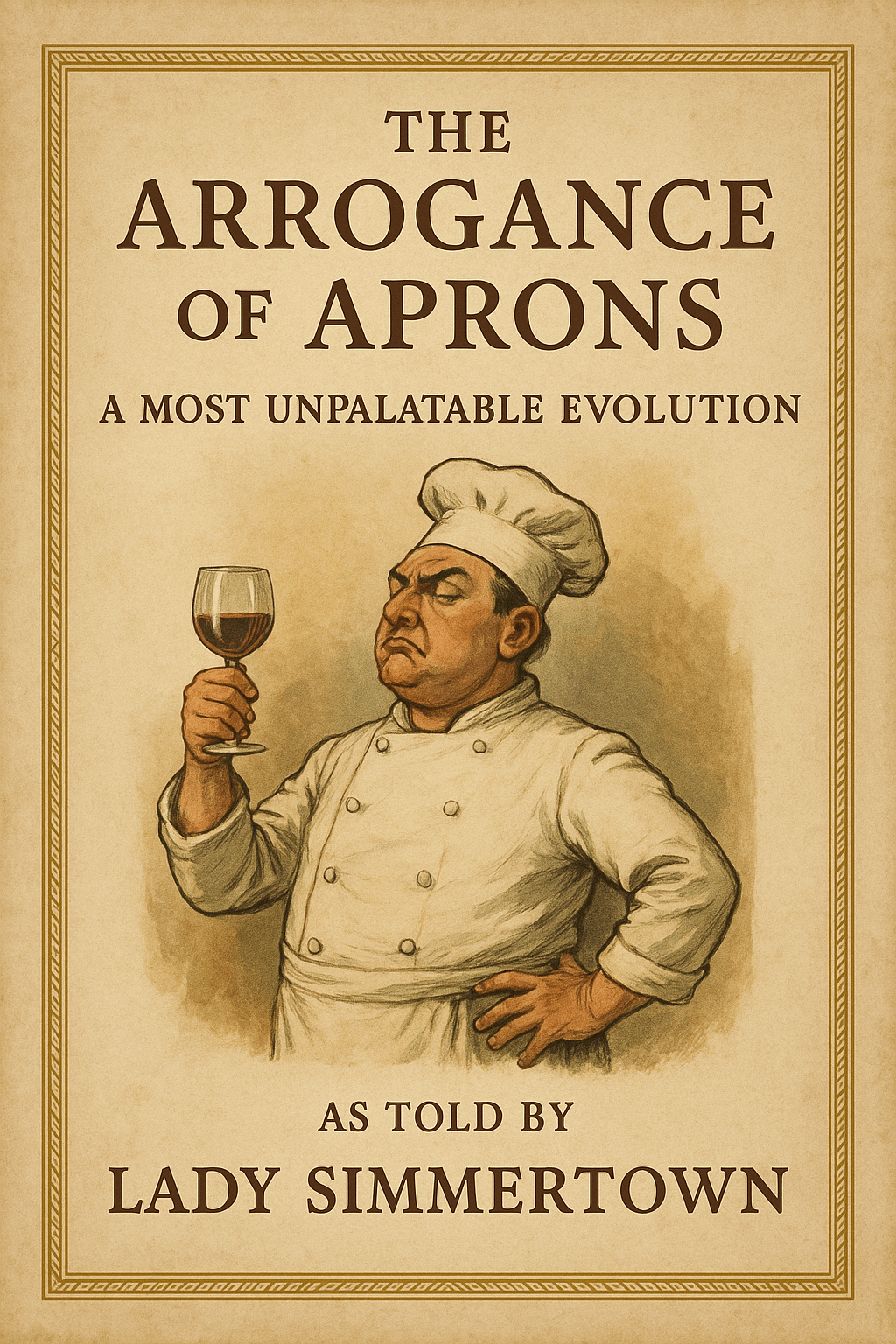
From humble hearth to social media throne, how chefs crowned themselves kings of cuisine.
My dearest readers, arrogance does not sprout overnight like parsley in a windowsill. No, it is cultivated over centuries, fertilized by power, inflated by reputation, and plated with theatrical flair. Today’s chefs, sneering at diners online and strutting about as though they alone discovered the sauté pan, are not an anomaly. They are the inevitable product of history, the spoiled fruit of a tree long watered with entitlement. Allow me, then, to unveil the lineage of this culinary conceit.
From Servants to Sovereigns (16th–18th Century)
Once, chefs were but shadows in the scullery. In the medieval courts of Europe, cooks were servants, scarcely worth a noble’s glance. Yet by the 16th century, as the Renaissance spread its gilded fingers across Europe, food became spectacle. Banquets dazzled not merely the palate, but the eye, with whole roasted peacocks re-feathered in plumage and sugar sculptures taller than courtiers.
It was here that arrogance first found footing. By the 17th century, France’s court kitchens under Louis XIV had turned cuisine into a political performance. Chefs like François Pierre La Varenne published Le Cuisinier françois in 1651, codifying French cuisine and elevating the cook from servant to artist. The message was clear: to cook was no longer merely to feed, it was to wield influence.
Carême and the Cult of Grandeur (1784–1833)
If arrogance required a patron saint, it was surely Marie-Antoine Carême. Born in 1784, Carême rose from humble beginnings to become the so-called “King of Chefs and Chef of Kings.” He sculpted towering pièces montées, confectionary palaces of spun sugar and marzipan, that astonished Europe. Emperors and tsars summoned him as though he were a diplomat.
Carême believed the chef to be an artist above common cooks, and his writings dripped with self-importance. His works helped cement the idea that cuisine was not simply craft, but haute art. Thus, arrogance was legitimized, dressed in sugar, gilded with status, and served on silver.
Escoffier’s Brigade: Kitchens Become Armies (1846–1935)
Enter Auguste Escoffier, the general of gastronomy. By the late 19th century, he reigned at the Savoy and the Ritz, codifying recipes and inventing dishes for royalty. His 1903 tome Le Guide Culinaire remains sacred scripture in kitchens to this day.
But more consequential than his recipes was his structure: the brigade de cuisine. Modeled after the military, it organized kitchens into strict hierarchies, chef de cuisine at the top, commis at the bottom, every station ranked with near-feudal precision.
This “efficiency” entrenched arrogance into the very marrow of professional kitchens. The chef became general, commander, sovereign. Orders flowed downward, never upward. Respect was demanded, not earned. Cruelty became institutional, justified by “tradition.”
The Age of Celebrity Chefs (20th Century)
In the 20th century, the curtain lifted further. Chefs stepped into the spotlight. Fernand Point (1897–1955) cultivated disciples in Lyon, declaring the chef a creative genius. By mid-century, television arrived.
Julia Child, bless her, democratized French cooking in America with The French Chef (1963). She laughed at mistakes, encouraged joy, and for a moment, humility seemed possible. But television soon demanded spectacle. By the late century, we saw flamboyant personalities like Emeril Lagasse shouting “BAM!” into cameras, making cooking into performance.
And then, dearest readers, came the cruelty-for-entertainment era. By the late 1990s and early 2000s, Gordon Ramsay was hurling insults across Hell’s Kitchen and Kitchen Nightmares, transforming arrogance into prime-time entertainment. Audiences laughed, networks profited, and young chefs learned the lesson: tyranny was not only tradition, it was lucrative.
Social Media: The Throne of the 21st Century
The 2010s delivered a new battlefield: Instagram, YouTube, Threads. Chefs no longer needed television, they could crown themselves emperors with nothing more than a ring light and a disdainful caption.
Now the arrogance spreads unchecked. A home cook shares her joy in boxed cake mix? She is mocked as inauthentic. A diner posts their love for Olive Garden? They are ridiculed as uncultured. A novice dares ask for advice? They are dismissed with a digital sneer.
Tweezers and tattoos replace humility; captions drip with sanctimony. “Real chefs don’t use recipes.” “Fast food is poison.” One can scarcely scroll without being scolded. The arrogance, once confined to kitchens, now trespasses boldly into living rooms.
The Cost of Centuries of Conceit
What began as a servant’s duty has become an emperor’s stage. But arrogance leaves ruin in its wake:
By the 21st century, kitchen burnout rates soared, with staff turnover in fine dining often exceeding 70%.
Culinary schools churn out indebted graduates, many of whom flee the industry within five years.
Entire food cultures are derided as “less refined” if they do not conform to French or Michelin standards.
Thus, arrogance has not only poisoned kitchens but diminished cuisine itself. What should nourish and unite instead humiliates and excludes.
A Call to Reformation
Yet all is not lost. For sprinkled among the tyrants are chefs who resist the inheritance of arrogance. Some champion collaboration over hierarchy. Others use social media to teach rather than to scold. They recall what history’s tyrants forgot: that food is for people, not for pride.
The chef must shed the crown, abandon the pulpit, and return to the hearth, for to cook is not to dominate, but to serve.
The Final Sting
So let it be known, my readers: the arrogance of aprons is no accident. It has been cultivated, rewarded, and passed down like a bitter heirloom through the centuries. Yet heirlooms, however ancient, may be discarded. Until chefs learn humility, let their sauces curdle, their stars dim, and their crowns tumble headlong into the stockpot where they so rightly belong.
For what stands before us is not a delicate soufflé, but a monument to ego, centuries in the making, plated with arrogance and garnished with disdain. Perhaps one day, a chef may lay down his crown for an apron and trade his sneer for a smile, though I confess I shall not hold my breath. Until that day arrives, I shall watch with pen poised, as the culinary world continues to season itself most liberally with hubris.
And after all, my dear readers, gossip, like garlic, improves almost any dish.
~ Lady Simmertown
For the Skeptics & the Scholars
Carême, Marie-Antoine. L’Art de la Cuisine Française. 1833.
La Varenne, François Pierre. Le Cuisinier françois. 1651.
Escoffier, Auguste. Le Guide Culinaire. 1903.
Mennell, Stephen. All Manners of Food: Eating and Taste in England and France from the Middle Ages to the Present. University of Illinois Press, 1996.
Ferguson, Priscilla Parkhurst. Accounting for Taste: The Triumph of French Cuisine. University of Chicago Press, 2004.
Trubek, Amy. Haute Cuisine: How the French Invented the Culinary Profession. University of Pennsylvania Press, 2000.
Spang, Rebecca L. The Invention of the Restaurant: Paris and Modern Gastronomic Culture. Harvard University Press, 2000.
Hollows, Joanne. Domestic Cultures. Open University Press, 2008.
Allen, Gary. A History of Professional Cooking. Greenwood Press, 1999.
National Restaurant Association reports on staff turnover and burnout, 2010s data.


 Butter, Ink & Indiscretion
Leave a comment