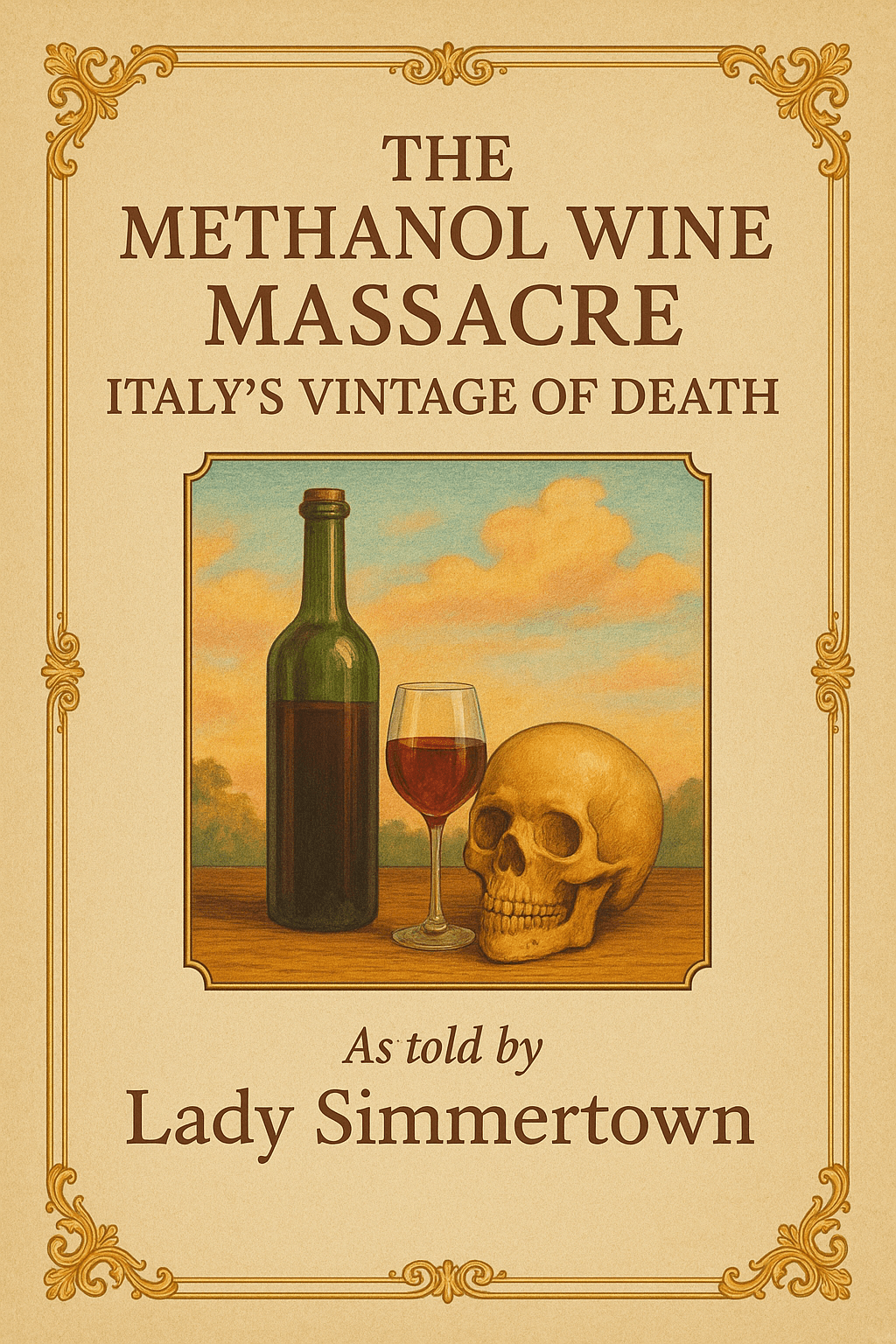
When greed soured the grape and turned wine into poison.
Dear Readers, A Toast Gone Rotten
Dearest readers, imagine: you lift a glass of Italian red, expecting the velvet kiss of Barbera upon your lips. Instead, the bouquet is betrayal, the aftertaste is agony, and the price of thrift is death itself. Such was the fate of hundreds in March 1986, when the noble wine of Piedmont, Italy’s cradle of Barolo and Barbera, became a chalice of poison.
The scandal that followed would shatter trust in Italian wine, topple merchants, and send shockwaves across Europe. For this was no isolated tragedy, but a calculated deceit, steeped in greed and poured into bottles by men who thought profit outweighed human life.
The Setting: Piedmont’s Humble Barbera
The tragedy centered upon Barbera, the working man’s wine of Piedmont. Unlike aristocratic Barolo or royal Barbaresco, Barbera was cheap, cheerful, and consumed daily by Italy’s middle and working classes. By the 1980s, Italy had become the world’s largest wine producer, exporting over 30 million hectoliters annually. But the industry was rife with corner-cutting: surplus grapes, cheap blends, and deceptive practices.
Into this climate crept the temptation of fraud. If one could stretch a weak vintage by adding a splash of methanol, industrial wood alcohol, the wine would appear stronger, richer, more alcoholic. No one, so the criminals believed, would be the wiser.
The Poisoned Vintage Emerges: March 1986
The massacre began quietly in early March 1986. In the small town of Narzo, near Milan, doctors noticed patients arriving with mysterious symptoms: blurred vision, convulsions, comas. Within days, the cause was traced not to spoiled food but to wine bottles laced with methanol.
The deaths mounted. By March 18, 1986, reports confirmed at least 23 fatalities and over 90 cases of blindness and neurological damage. Most victims were ordinary Italians: pensioners buying table wine, laborers celebrating at home, families sharing Sunday meals. Their crime was thrift; their punishment, permanent.
The Conspiracy in the Cellar
Investigators uncovered a sordid trail leading back to Giovanni Ciravegna, a small wine producer from Narzo, and his associates. They had deliberately doctored wines with methanol to increase apparent alcohol levels, sometimes up to six percent more than nature allowed.
Authorities raided warehouses and found hundreds of thousands of liters of poisoned Barbera, stored under respectable labels. At least 11 wine companies were implicated, and the scandal quickly spread beyond Piedmont, tainting bottles across northern Italy.
Europe Turns Away
The scandal was not contained within Italy’s borders. The poisoned wines had already reached export markets. In France, Germany, Denmark, and the United States, importers panicked. Supermarkets pulled Italian wines from shelves, and governments issued bans.
The economic toll was staggering: in just months, Italy’s wine exports fell by nearly 40%, and its global reputation collapsed. Even noble wines like Chianti and Brunello were eyed with suspicion. The proud heritage of Roman bacchanals and Renaissance vineyards was now whispered with the shameful epithet: vino assassino, “killer wine.”
The Reckoning: Trials and Reform
Italian police seized more than 600,000 gallons of tainted wine. By 1988, trials were underway. Ciravegna and accomplices were convicted of multiple counts of manslaughter and sentenced to long prison terms.
But the greater reckoning was legislative. In the wake of scandal, Italy tightened its Denominazione di Origine Controllata (DOC) laws, enforcing stricter monitoring, labeling, and chemical analysis. European food safety laws, too, grew harsher, requiring traceability and laboratory testing. The Methanol Massacre became the grim catalyst for modern wine regulation.
The Long Shadow
Though reforms improved quality, the stain endured. In the late 1980s, Italian producers fought desperately to rebuild trust. Piedmont growers launched quality campaigns, insisting on strict yields and better vintages. Yet, even decades later, the massacre lingers in memory. In tastings and trade fairs, whispers still arise: “Will this be another methanol scandal?”
The irony is bitter: the fraudsters sought quick profit, but in doing so, they jeopardized centuries of Italian viticulture. As one judge declared at trial: “They poisoned not just people, but the very soul of Italian wine.”
A Caution in the Cup
So let this woeful vintage, my dear readers, stand as a warning etched in crimson: the cup that promises comfort may conceal calamity when greed governs the grape. In 1986, Italy’s humble Barbera became not a balm of conviviality, but a venom of treachery, proof that even a nation’s proudest heritage can be soured by avarice in the cellar.
Raise your glass if you must, but remember: every sip is a pact of trust between vintner and drinker. May your wine bear only the kiss of the grape, and never again the cold embrace of death.
~ Lady Simmertown
For the Skeptics & Scholars
BBC Archives (March–April 1986)
Journal of Wine Economics, “The Methanol Wine Scandal and Its Aftermath,” 2016
John Mariani, How Italian Wine Rebuilt Its Reputation (1990s)
European Commission Reports on Food Safety, 1986–1988
Italian Court Proceedings, Turin, 1988


 Butter, Ink & Indiscretion
Leave a comment