Dear Readers,
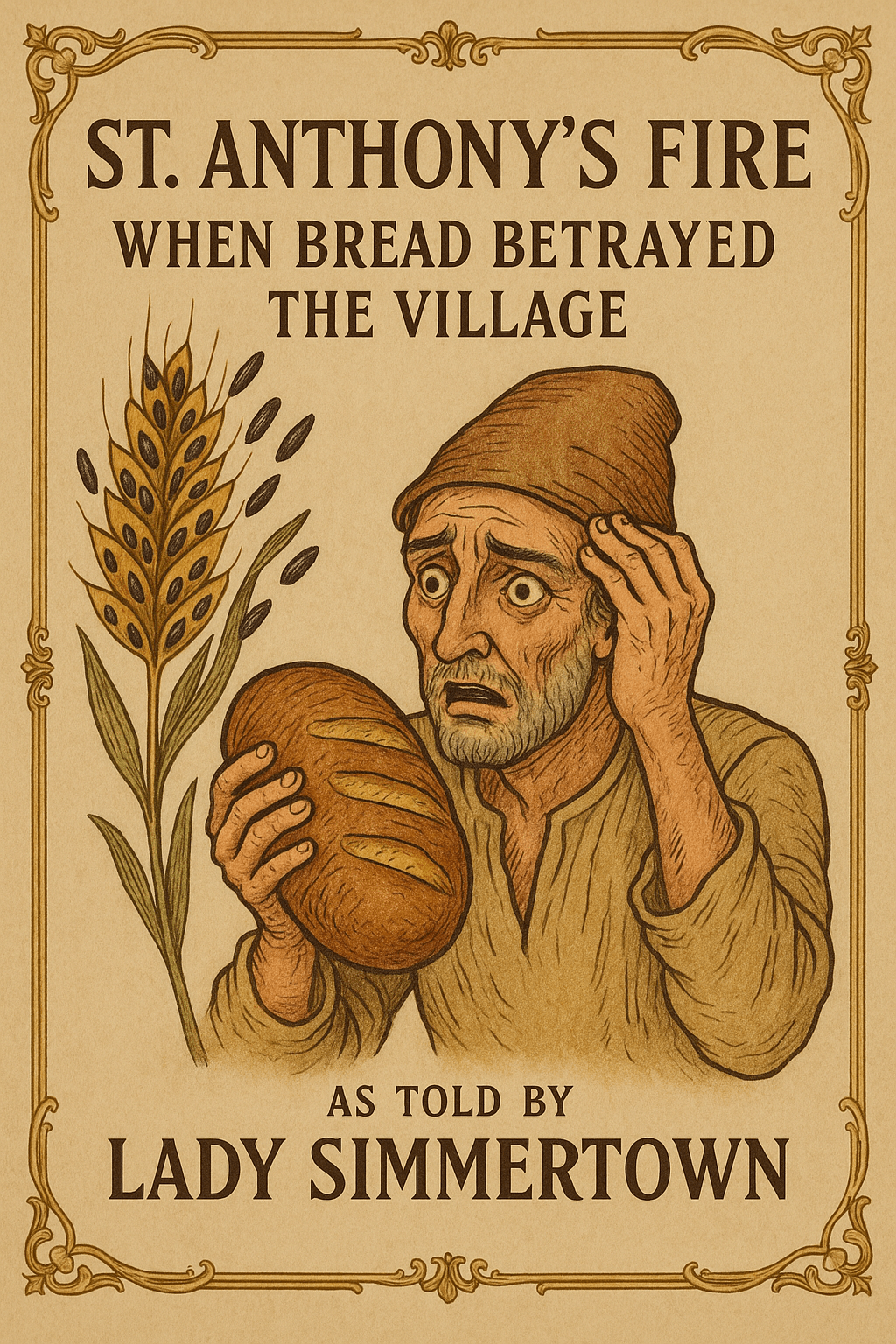
Pray gather round, for I bring you a scandal so dreadful it singed not only the flesh of the poor, but the very reputation of bread itself. In the damp, unassuming fields of Europe’s countryside, rye was once the loyal sustainer of peasants. Yet within its dusky grains lurked a villain in disguise: Claviceps purpurea, a parasitic fungus with a flair for both drama and destruction.
Once baked into loaves, this wretched interloper delivered not nourishment, but torment, convulsions, visions of hellfire, and limbs consumed as though by invisible flame. Thus was born the terror known as St. Anthony’s Fire, a name whispered through cloisters and cottages alike, as entire villages fell beneath its cursed spell.
A Burning Affliction (857 CE and Beyond)
The first whispers of this fiery plague appear in 857 CE, when a Saxon chronicle recorded that “a great plague of swollen blisters” seized the people, their flesh blackened and falling away. Imagine, dear readers, not the noble death of the battlefield, but toes and fingers slipping from one’s hand like overripe fruit! By the 10th and 11th centuries, such horrors visited France and Germany with frightening regularity, striking most cruelly at the poor, who depended upon rye while their betters dined on purer wheaten loaves.
Two forms of scandal reigned:
- The gangrenous, where blood ceased to flow, leaving extremities to rot and drop like discarded gloves.
- The convulsive, where villagers thrashed, trembled, and shrieked, their minds set ablaze with visions of demons and heavenly lights.
In short, a banquet of suffering served at the peasant’s table.
Monks, Miracles, and a Blue Cross (1095 Onward)
Enter the Order of St. Anthony, founded in 1095 in the Dauphiné region of France. These holy brothers, robed in black and bearing a blue cross, devoted themselves to tending the afflicted. Pilgrims limped, burned, and convulsed their way to Antonine hospitals, where they were fed, scandalously enough, not relics or charms, but simple bread made of clean wheat.
And lo! The “miracle” often occurred. Yet one might whisper, was it the saint’s intercession, or merely the absence of poisoned rye? Faith and fungus danced together, each taking credit while the poor clutched their rosaries in one hand and their bread in the other.
Witchcraft by Loaf (15th–17th Centuries)
Ah, but the tale grows darker still. By the 15th century, outbreaks of St. Anthony’s Fire coincided with a wave of witch trials sweeping across Europe. In France (1596), thousands perished, while in the German city of Erfurt between 1596 and 1636, convulsions and visions seized so many that whispers of sorcery took root. Were these not signs of demonic possession? Women shrieking, children trembling, visions of devils with horns and tails, all most conveniently blamed upon witches.
And let us not forget the scandal across the Atlantic. In 1692, the village of Salem erupted in a frenzy of accusations. Young girls, thrashing, screaming, and claiming spectral visions, pointed trembling fingers at their neighbors. Could damp New England rye, laced with ergot, have been the true culprit? Some modern scholars suggest so, though others clutch their pearls and declare it nonsense. Yet the resemblance remains too delicious to dismiss entirely.
From Curse to Cure (17th–19th Centuries)
By the late 17th century, men of science dared to strip the fungus of its mystery. In 1676, French physician Denis Dodart described its strange growths. By 1778, Samuel-Auguste Tissot declared rye bread its vehicle of poison. And yet, such is the scandal of history, midwives soon turned the fungus from curse to cure. Its alkaloids forced wombs to contract, hastening childbirth, though too often at the peril of mother and babe alike. One must ask: what is progress, when it arrives arm-in-arm with peril?
The Devil Becomes a Chemist (20th Century)
The true transformation came with the dawning of the modern age. In 1918, chemist Arthur Stoll isolated ergotamine, a treatment for migraines. But the greater scandal arrived in 1938, when Albert Hofmann of Switzerland concocted lysergic acid diethylamide, LSD, born from ergot’s infernal chemistry. On an April afternoon in 1943, Hofmann became the first man to ride what he called his “bicycle day” of visions, not unlike those convulsive peasants of old. What once condemned women to the pyre now fueled psychedelic revolutions.
Final Musings
Thus, dear readers, the tale of St. Anthony’s Fire is not one of mere sickness, but of society undone: peasants crippled, saints glorified, witches condemned, and scientists enthralled. From the Saxon chroniclers of 857 CE to the countercultural rebels of the 1960s, ergot has forever danced between torment and transcendence.
So, when next you break bread, give thanks that the loaf before you is not a vessel of visions, but a harmless companion to butter and jam. For had you dined in centuries past, you might have found yourself not at table, but at stake.
Forever fanning the flames of culinary scandal,
Lady Simmertown
For the Skeptics & the Scholars
Bové, J. (1970). The Story of Ergot. Basel: S. Karger.
Caporael, L. (1976). “Ergotism: The Satan Loosed in Salem?” Science, 192(4234), 21–26.
Matossian, M. K. (1989). Poisons of the Past: Molds, Epidemics, and History. Yale University Press.
Dodart, D. (1676). Mémoires sur le Seigle ergoté. Paris.
Hofmann, A. (1980). LSD: My Problem Child. McGraw-Hill.


 Butter, Ink & Indiscretion
Leave a comment