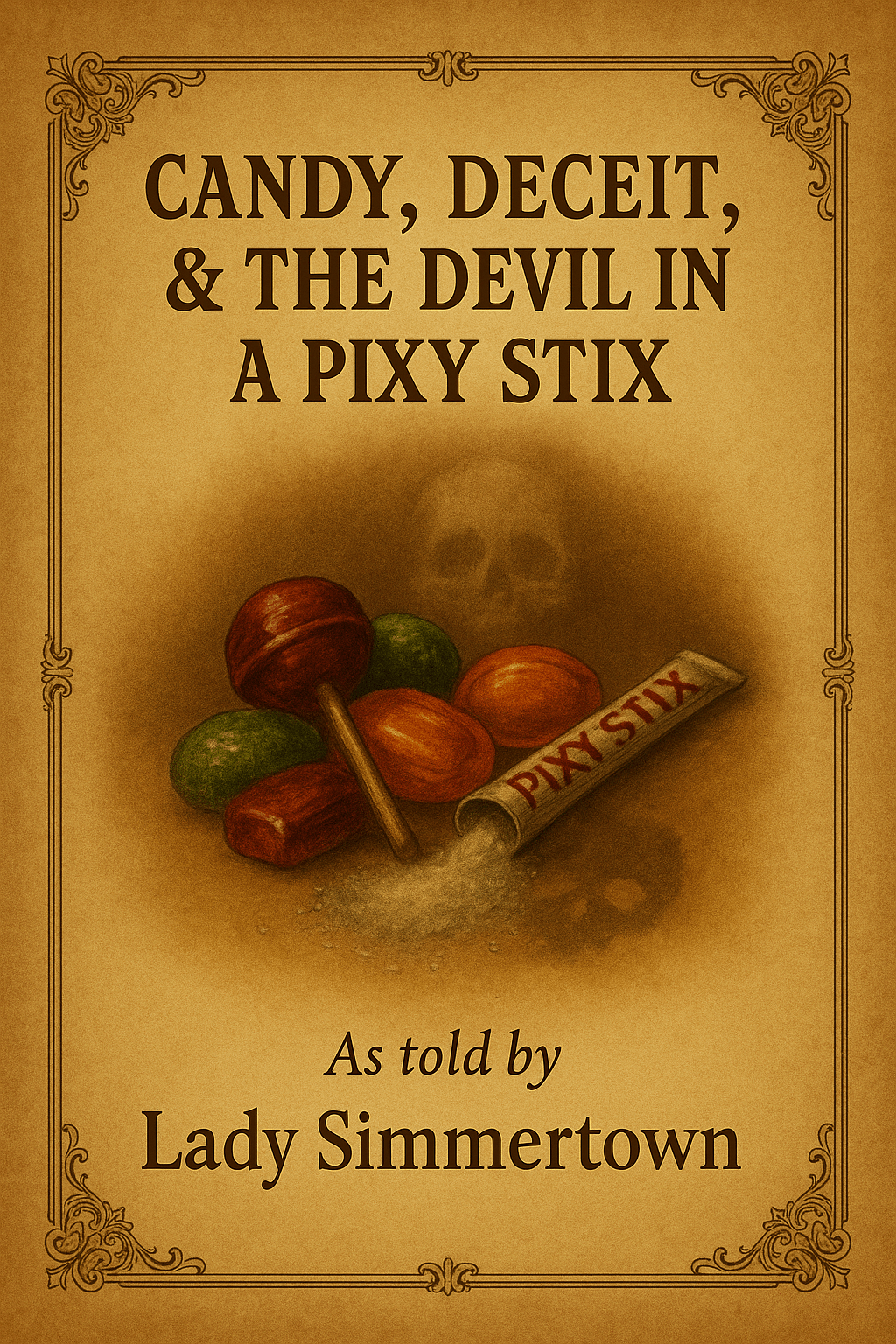
Sweetness curdled. Trust undone. Halloween reborn in horror.
Dearest Readers,
Gather close, for tonight’s tale is sugared with deceit and dusted with death. It begins not in the gothic manors of Europe but in the neat lawns of 1970s suburban Texas, where the greatest horror was thought to be cavities. Yet on the night of October 31st, 1974, beneath plastic pumpkins and polyester costumes, the Devil himself wore a father’s face.
Let us unwrap, together, the scandal that turned a nation’s sweetest holiday into a feast of fear.
The Autumn of Trust (America, 1974)
The 1970s were an anxious decade, my dear, Watergate had eroded faith in government, inflation gnawed at the middle class, and The Exorcist had convinced half the nation that Lucifer might be living in the basement. But Halloween? Halloween remained sacred, an innocent bacchanal of sugar and superstition.
Children roamed freely through the suburban night, their pillowcases swelling with treasure, while mothers at home warmed cider and watched Charlie Brown and the Great Pumpkin. No one locked their doors. No one suspected the horror that would soon be born in Pasadena, Texas.
The Boy, the Candy, and the Cyanide
Eight-year-old Timothy Marc O’Bryan had dressed as a cowboy, boots clattering down the pavement as he hunted for sweets with his sister, Elizabeth. Their father, Ronald Clark O’Bryan, accompanied them, feigning paternal charm while quietly clutching his financial ruin.
That night, Ronald handed his son a giant Pixy Stix, a paper tube of powdered sugar sealed with a staple. Within it lay 270 milligrams of potassium cyanide, enough to kill not only Timothy, but two adults besides. Moments after swallowing, the child cried that the candy tasted bitter. He collapsed. He was dead before midnight struck.
The Perfect Alibi: A Stranger’s Door
Police arrived to find hysteria, horror, and the beginnings of America’s greatest modern myth. Ronald wept theatrically, insisting the poisoned candy came from a darkened house whose door had “never fully opened.” He claimed a faceless stranger’s hand had passed the Pixy Stix through the gap.
The press pounced. The Houston Chronicle blared warnings of “CANDY KILLER ON THE LOOSE.” Within twenty-four hours, radio stations from California to Maine echoed the panic. Parents threw out chocolate by the ton. Hospitals offered free X-rays for treats. Trick-or-treating plummeted.
And thus was born the legend of the Halloween Poisoner.
The Man Behind the Mask
Detectives, unimpressed by theatrics, began to notice peculiar details. Ronald was $100,000 in debt, had recently taken out $60,000 in life insurance policies on his children, and owed money to nearly every acquaintance. He’d also asked a friend, days before the crime, where one might buy cyanide.
The police soon learned that none of Ronald’s neighbors had distributed Pixy Stix that evening. The candy came not from a stranger’s door, but from Ronald’s own kitchen drawer. The benevolent father had become a merchant of death.
The Trial of 1975: America’s Sweetest Villain
The trial was a spectacle worthy of the stage. Reporters dubbed him “The Candy Man”, though unlike the honeyed crooner of legend, this one sang only for money. Prosecutors presented chemical analysis proving that four other Pixy Stix, meant for other children, had been similarly poisoned but never eaten. Ronald had distributed them to deflect suspicion, sealing each tube with staples because, as he told police, “the powder kept spilling.”
The jury deliberated for just forty-six minutes. On June 3rd, 1975, Ronald Clark O’Bryan was convicted of capital murder. The judge pronounced his sentence in solemn tones: death by lethal injection.
America Loses Its Sweet Tooth
Though the crime was singular, its shockwaves were not. Across the late 1970s and ’80s, fear metastasized into ritual paranoia. Cities from Chicago to San Francisco enacted curfews. Parents forbade homemade treats. Candy companies saw profits dip each November.
Even as sociologists confirmed that no verified case of stranger-tampered candy ever occurred before or after O’Bryan, the myth devoured reason. Halloween had been permanently transformed from innocent delight to ritual of suspicion.
In 1984, when the Candy Man met his own poisoned fate by needle in Huntsville Prison, protestors outside chanted “Trick or treat!” as fireworks lit the night. America, in its macabre way, celebrated poetic justice.
Fear in a Wrapper
Decades later, new panics rose from the same mold. In the 1980s, it was razor blades in apples. In the 1990s, heroin-laced candy. By 2022, the spectre was “rainbow fentanyl.” Each was breathlessly reported, rarely verified, yet deeply believed.
Psychologists call this “the moral panic of domestic betrayal.” We fear not the stranger, but the parent, the neighbor, the smiling man with a bowl of sweets. For what greater horror exists than evil wearing trust as its costume?
The Bitter Moral of the Bonbon
And so, dearest readers, let us draw the moral from this sugared tragedy: that not all poison comes in vials. Some is wrapped in cellophane and tied with a father’s bow of deceit.
Each Halloween since 1974, as porch lights glow and children’s laughter pierces the dusk, America reenacts this haunted lesson. Fear has become our annual confection, crunchy, colorful, and impossible to stop consuming.
So when you unwrap your sweets this year, whisper a prayer for little Timothy, for the innocence that died with him, and for a nation that still cannot tell where myth ends and malice begins.
Yours in scandal and suspicion,
~ Lady Simmertown
For the Skeptics & the Scholars
- Blum, Deborah. The Poisoner’s Handbook: Murder and the Birth of Forensic Medicine in Jazz Age New York. Penguin Press, 2010.
- State of Texas v. Ronald Clark O’Bryan, Case No. 74-C-193, Harris County District Court, 1975.
- National Safety Council Reports on “Halloween Candy Tampering,” 1974–1990.
- Snopes Archives: “Halloween Poisoned Candy Myths,” updated 2023.
- Marwick, Alice. Moral Panics in the Suburbs: The Halloween Candy Case and American Fear. Journal of Cultural Sociology, 2019.
- Houston Chronicle, November 1–10, 1974 coverage archives.
- CNN Retrospective, “The Man Who Killed Halloween,” 2004.


 Butter, Ink & Indiscretion
Leave a comment