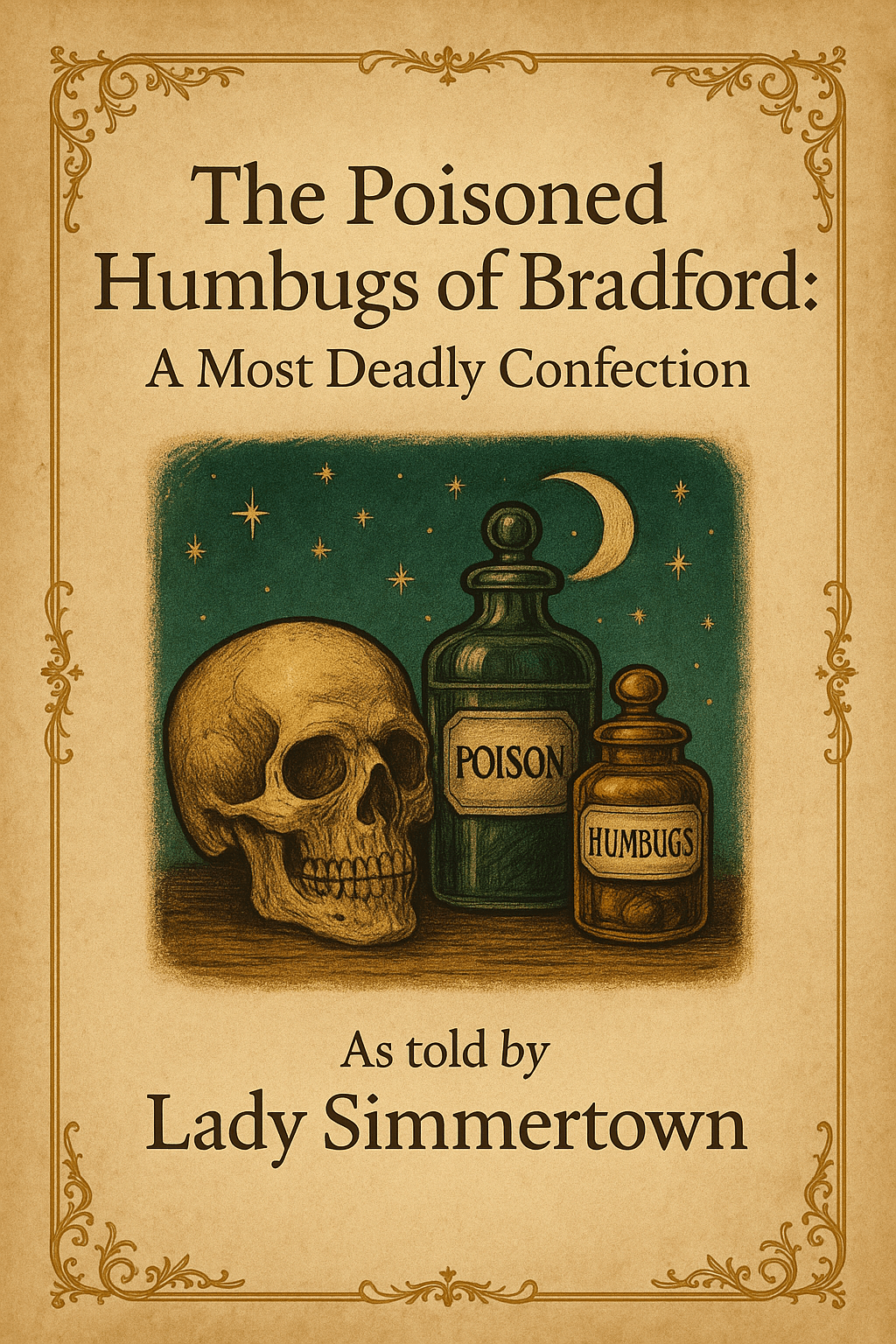
Where sweetness met its most sinister suitor.
Dearest readers,
There are murders one can trace to daggers and duels, yet the deaths I recount tonight were committed by peppermint lozenges.
On Saturday, the 30th of October, 1858, the industrious town of Bradford, Yorkshire, already choked by the soot of the Industrial Age, found itself visited by a quieter horror, one delivered not by a highwayman’s pistol, but by the gentle clink of a sweet-shop scale. By midnight, a handful of humbugs had slain twenty souls, and the papers would soon christen it “The Great Bradford Sweet Poisoning.”
The Confectioner’s Chain of Misfortune
At the heart of the affair stood Joseph Neal, a modest confectioner on Green Market, who prepared peppermint lozenges for a popular street vendor named William Hardaker, known to locals as “Humbug Billy.” Neal, wishing to stretch his costly sugar, sent his assistant to a nearby apothecary, Hodgson’s Drug Store, to purchase a cheap filler called “daff” — powdered gypsum, the sort used in candy and plaster alike.
But fate, ever mischievous, placed a poisoner’s hand upon the scales. The druggist’s assistant, the hapless William Goddard, mistook a cask of arsenic trioxide, a deadly white powder, for daff. The two substances, you see, were near identical to the eye, though one sweetened the purse and the other scorched the blood.
The Mixing of Death
Oblivious to the error, Neal’s sweet-maker James Appleton blended twelve pounds of the fatal powder into the day’s peppermint batch. The humbugs were rolled, cut, and dried in trays, their minty scent masking the reek of mortality.
According to later inquests, each individual sweet, contained between 14 and 16 grains of arsenic, nearly enough to kill twenty adults per lozenge. By dusk, forty pounds of poisoned candy had been dispatched to Hardaker’s stall, and the stage was set for one of Victorian Britain’s most ghastly food scandals.
The Saturday Evening Rush
That brisk October night, families bustled through the market for a penny’s worth of pleasure. Children pressed their noses to Hardaker’s glass jars, their coins shining from coal-blackened palms. “Humbug Billy,” coughing from his own affliction, sampled one sweet himself, and by the time the church bells tolled nine, he was vomiting violently in the street.
Across Bradford, similar scenes unfolded. Those who had tasted the lozenges complained of a burning in the throat, an ice in the limbs, and a pain like fire beneath the ribs. Apothecaries worked by candlelight, bleeding patients and dosing them with milk and castor oil, unaware that the cure lay only in stopping the sweets themselves.
The Toll of the Dead
By Sunday morning, October 31st, the joyous air of market day had curdled into grief. Among the first to perish were young Samuel Waite, aged five, and Ann Walmsley, a mother who had shared her bag with her children.
Coroner’s records later confirmed 21 fatalities (some reports cite 20) and over 200 poisonings within a single night, a number extraordinary for its speed and scope.
Dr. John Bell, who performed the post-mortem examinations, declared:
“So large is the quantity of arsenic, that one of these lozenges could destroy not one, but twenty men.”
Thus did a peppermint sweet become the weapon of an invisible mass murderer.
The Inquiry and the Outrage
The official inquest opened at the Bradford Town Hall on November 1st, 1858, drawing crowds so vast that constables had to bar the doors. The public, horrified yet morbidly fascinated, demanded a villain to hang.
Yet the coroner, Mr. Thomas Taylor, found no malice, only negligence, ignorance, and a society drunk on profit. Goddard the assistant had been careless; Neal the confectioner had not tested his ingredients; and Hodgson the druggist had stored poison beside food additive.
The Leeds Mercury thundered, “If this be not murder, it is murder’s twin.”
No man was executed, though the scandal’s echo reached the halls of Parliament, where reformers decried the ease with which death could masquerade as sugar.
The Birth of Food Safety
In 1860, two years later, the outrage borne of Bradford’s tragedy culminated in the Adulteration of Food and Drink Act, Britain’s first legal measure against tampering and contamination.
Inspectors could now seize goods, test for toxins, and prosecute deceitful merchants. Arsenic, once used freely in green dyes, cosmetics, and even wall paper, began to vanish from domestic trade.
And yet, the deaths of those twenty souls became a moral parable: that the modern world’s miracles, its chemistry, its factories, its convenience, carried devils of their own.
The Haunting Legacy
To this day, St. George’s Hall in Bradford still holds records of the inquest, and descendants speak of ancestors felled by the “killer humbugs.” Some claim the sweet shop on Stone Street remained empty for decades, its threshold shunned by children who whispered that a faint smell of mint and death lingered in the air.
So, dear readers, should you unwrap a candy this Halloween and find its sweetness oddly bitter, remember the poor souls of Bradford. They bit into innocence, and tasted the grave.
Thus concludes the dreadful chronicle of the poisoned humbugs, a tale reminding us that even pleasure, when adulterated by greed or folly, may don the mask of the Reaper himself.
Beware, my dears, the confectioner’s grin. For in every bag of sweets lies the faint possibility of history repeating itself.
Ever yours in sugared terror,
Lady Simmertown


 Butter, Ink & Indiscretion
Leave a comment