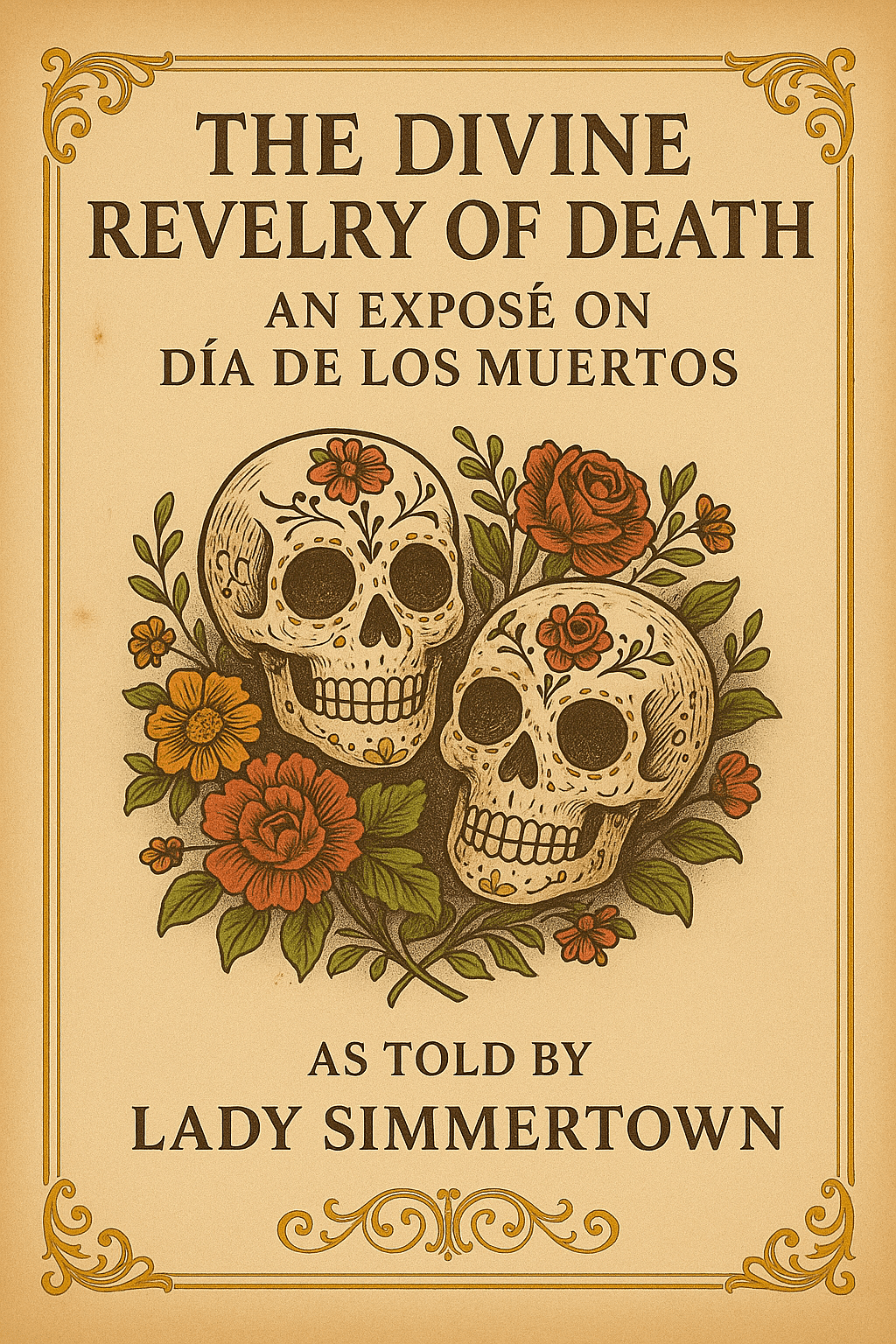
Where death wears a flower crown and the afterlife arrives fashionably late.
Death, Darlings, but Make It Divine
My dear readers,
Permit me to disturb your tranquil sensibilities with an observation most improper: in Mexico, death throes a party. While much of the Western world dresses bereavement in black crepe and hushed tones, the Mexican spirit bedecks the grave in marigolds, sugar, and laughter. Día de los Muertos, the Day of the Dead, is not a macabre jest, but a love letter written to mortality itself, signed in candle wax and cocoa.
Let us, then, unravel the ribbons of this resplendent ritual, a festival where pre-Columbian devotion waltzes with Catholic guilt, and where death, of all things, is dressed to delight.
The Ancient Overture: Before the Cross Came South
Long before the Spanish set foot upon the rich soils of Mesoamerica, the peoples of the Mexica (Aztec), Maya, and Purépecha had already made their peace, and indeed, their revelry, with death. Archaeological evidence from as early as 1800 BCE shows offerings of food and jade left for ancestors, proof that the conversation between the living and the dead was already well underway.
Among the Mexica, death was not an end but a continuation. The great goddess Mictecacihuatl, Queen of Mictlan, the underworld, presided over the bones of the departed. She was honored in festivals that spanned entire lunar cycles, especially during the ninth month of the Aztec calendar (around August), when offerings of maize, flowers, and amaranth effigies were made to nourish the souls of the dead.
When the Spaniards arrived in 1519, led by Hernán Cortés, they brought not only steel and scripture but also a theology unaccustomed to such mirthful mortality. To their European eyes, these death rites appeared pagan and perilous, yet even as friars wielded crosses and catechisms, they found themselves unable to suppress the sheer radiance of remembrance among the people.
A Holy Compromise: When Faith Met Fiesta
By the 16th century, Spanish Catholicism had intertwined with Indigenous spirituality in a cultural pas de deux that neither side could wholly claim nor deny. The Church, ever pragmatic, shifted the ancient death festivals to coincide with All Saints’ Day (November 1st) and All Souls’ Day (November 2nd), thus birthing the modern Día de los Muertos.
Indigenous altars, once dedicated to deities like Mictecacihuatl, were redressed as ofrendas, home shrines laden with crosses, candles, and images of saints, but still gleaming with maize, copal incense, and the favorite dishes of departed kin. Sugar, recently introduced from Europe, found its eternal form in calaveras (sugar skulls) by the 17th century, a sweet and symbolic resurrection of pre-Hispanic offerings.
Even the marigold (cempasúchil), native to Mexico, retained its ancient role as the “flower of the dead,” guiding souls with its blazing hue and perfume. To this day, its petals form golden pathways believed to lead spirits home.
The Nineteenth Century Revival: Satire, Skulls, and Scandal
The 1800s, darlings, were a turbulent era. Mexico had won its independence in 1821, only to lose half its territory by mid-century and endure waves of social upheaval. Amid the chaos, Día de los Muertos evolved from quiet familial remembrance into a vibrant act of cultural defiance.
It was during the Porfirian era (1876–1911) that the skeletal imagery we so adore was popularized by José Guadalupe Posada, the mischievous printmaker who birthed La Calavera Catrina. This elegant lady of death, bedecked in her French hat and eternal smirk, was a satire of upper-class vanity, and she remains, to this day, the unofficial muse of the holiday. How fitting that death, personified, should mock the living for their pretensions!
Modern Reverence: From Suppression to Celebration
In the 20th century, Mexico’s intellectuals and artists, from Diego Rivera to Frida Kahlo, reclaimed Día de los Muertos as a national emblem of identity. Rivera’s 1947 mural Dream of a Sunday Afternoon in Alameda Park immortalized La Catrina at the heart of Mexico’s historical pageant, forever entwining death with art, politics, and beauty.
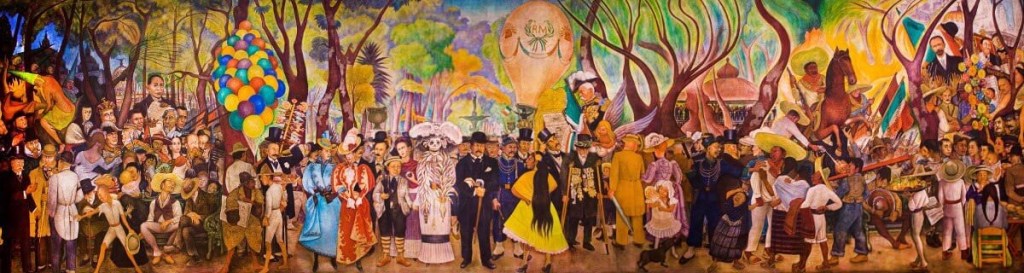
Even the Church, once suspicious, now participates in processions and prayers, acknowledging that faith and festivity can share the same altar. UNESCO, in 2008, declared Día de los Muertos an Intangible Cultural Heritage of Humanity, cementing it as one of the world’s most exquisite fusions of ancient devotion and modern artistry.
A Toast to the Departed
So, my radiant companions, let us not mistake Día de los Muertos for mourning in masquerade. It is remembrance elevated to ritual, grief made glorious, love so persistent it crosses the veil itself. Where others whisper prayers to tombstones, Mexico raises a goblet to eternity, filled, perhaps, with atole or pulque, and drinks to the divine comedy of existence.
In a world that fears death’s touch, the Mexicans dance with her, and somehow, in their joy, make her beautiful.
Ever yours in scandal and scholarship,
Lady Simmertown
For the Skeptics & the Scholars
UNESCO. “Day of the Dead (Día de los Muertos).” Intangible Cultural Heritage Lists, 2008.
Paz, Octavio. The Labyrinth of Solitude. Grove Press, 1950.
Brandes, Stanley. Skulls to the Living, Bread to the Dead: The Day of the Dead in Mexico and Beyond. Wiley-Blackwell, 2006.
López Austin, Alfredo. The Human Body and Ideology: Concepts of the Ancient Nahuas. University of Utah Press, 1988.
Carmichael, Elizabeth & Sayer, Chloë. The Skeleton at the Feast: The Day of the Dead in Mexico. University of Texas Press, 1991.
Posada, José Guadalupe. La Calavera Catrina (etching, circa 1910).
National Institute of Anthropology and History (INAH, Mexico). Archives on Indigenous and Colonial Rites, 2020.


 Butter, Ink & Indiscretion
Leave a comment