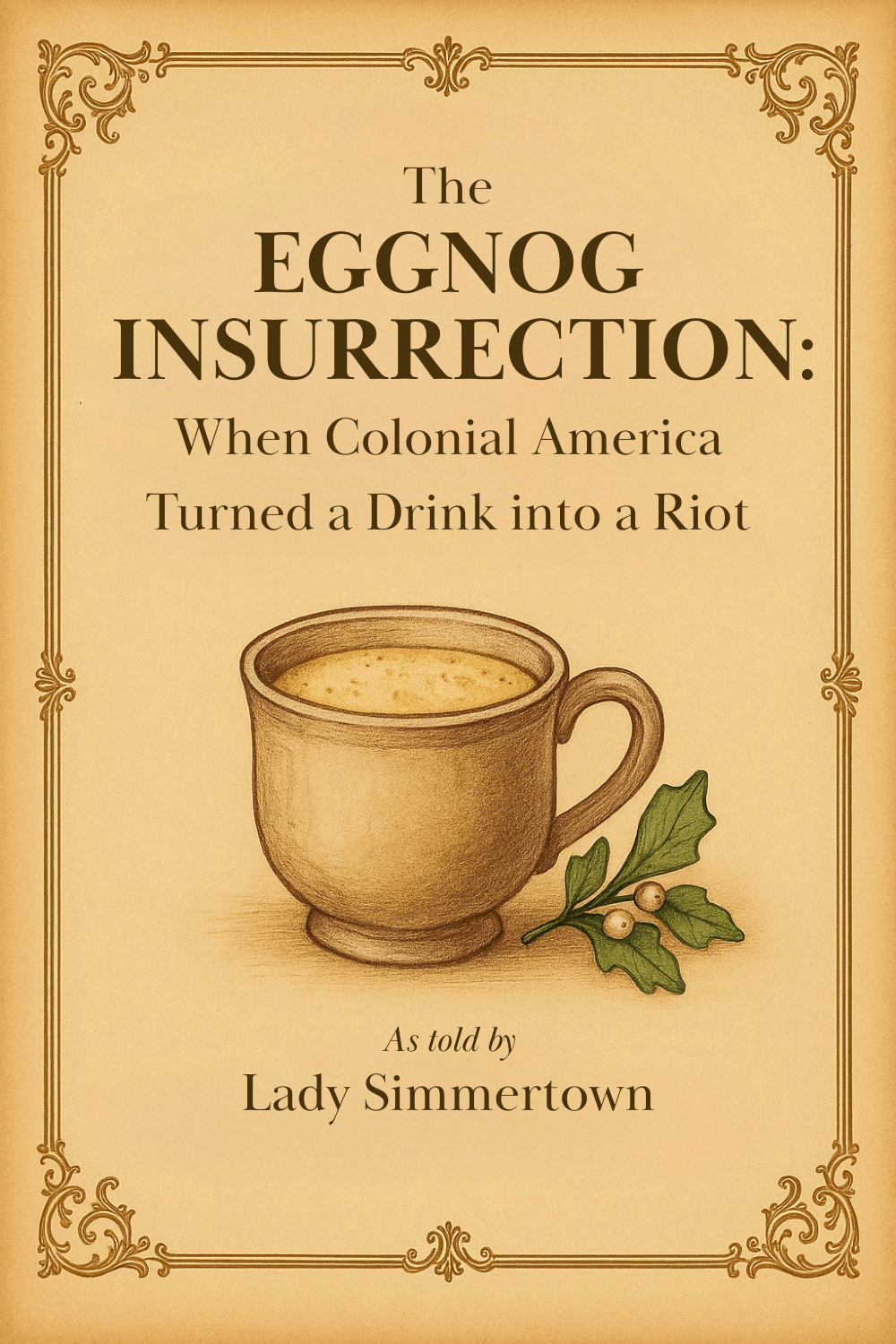
A Yuletide Tale of Fermented Folly and Military Mayhem
Dear Readers,
Gather close, warm your hands upon the hearth, and prepare your most dramatically embroidered shawl, for tonight’s chronicle is no gentle fireside yarn. No, indeed. It is a tale so unrestrained and so utterly soaked in whiskey soaked audacity that one might suspect the Muses themselves were tipsy when they whispered it into history’s ear.
On Christmas Eve of 1826, the esteemed halls of the United States Military Academy at West Point, that temple of discipline founded in 1802, played host not to angelic carolers nor pious cadets deep in prayer, but to a riot. A true riot. A brawl of such spectacular absurdity that even the stern faced Superintendent Colonel Sylvanus Thayer, the very architect of American military rigor, was left clutching his ledgers and questioning every life choice that had led him to that moment.
My darlings, brace yourselves. This is the night America’s future officers staged an uprising over eggnog.
A Nation Obsessed With Nog
To understand the catastrophe that unfolded in 1826, you must first appreciate the near religious devotion early Americans had for their holiday tipple. Eggnog, descended from the British posset, which emerged in medieval Europe between the 1200s and 1600s, became an American obsession by the late 1700s. Colonial households whipped it with Jamaican rum, French brandy, or whatever intoxicant could be procured without sparking a marital dispute.
By 1790, newspapers from Boston to Charleston were publishing lavish holiday nog recipes, some calling for so much rum that the eggs and cream were, in truth, mere symbolic gestures. George Washington himself penned a famously potent batch featuring rye whiskey, rum, and sherry, a beverage that by all accounts may have felled half a regiment.
So imagine the horror, dear readers, when West Point, staunch and sober and unyieldingly proper, banned alcohol in 1825 as part of Thayer’s sweeping reforms to turn unruly boys into respectable officers.
Naturally, the boys vowed to rebel.
Cadets With a Cunning Plan
With Christmas 1826 approaching, several cadets found the prospect of a dry and joyless celebration as intolerable as under seasoned gruel. Tradition demanded eggnog. Eggnog demanded spirits. The Academy demanded obedience. And thus the cadets demanded subterfuge.
Enter William Billy Murdoch, Jefferson Davis’s future roommate although Davis himself was not involved, and a lively supporting cast of daring young men who decided they would circumvent prohibition with a plan so audacious it deserved its own operatic overture.
Late on December 23, Murdoch and two associates slipped past campus guards and rowed across the icy Hudson River to the village of Highland Falls. Their mission was to acquire alcohol from local taverns, chief among them the notorious Benny Havens Tavern, already famous for its generous pours and lax supervision.
They returned with an estimated three to four gallons of liquor, whiskey, rum, and whatever else poor Benny had managed to keep stocked despite the winter freeze.
West Point had no idea what was about to hit it.
The Eve Begins Too Merrily
By the afternoon of December 24, the boys were mixing their clandestine creation. In the North Barracks, Company C set about preparing a punch bowl so enormous and so heavily fortified that one wonders whether the eggs even realized they were present.
As the sun lowered itself behind the Hudson, the merriment began with innocent toasts. Then less innocent toasts. Then toasts to toasts. The cadets, dressed in their stiff uniforms, loosened collar buttons and decorum alike as their nog laden bravado increased.
By midnight, the barracks had surrendered entirely to bedlam. Off key patriotic ballads drifted through the hallways as though Francis Scott Key himself were begging for mercy. Philosophical debates erupted between doorways, each participant convinced he alone understood the true nature of democracy. Improvised military drills took shape in the corridors, performed with a chaotic enthusiasm that no instruction manual had ever endorsed. And beneath it all came the unmistakable clatter of boys attempting, with transparent futility, to behave as though they were not drunk when every wobbling step betrayed them.
If ever the Academy yearned for divine intervention, this was certainly the moment.
When Festivity Turned to Folly
Shortly after midnight, around 12:45 a.m. on December 25, the situation deteriorated from spirited to berserk.
Cadet James W. Moore, thoroughly marinated in nog, began smashing furniture with the zeal of a man possessed by both holiday cheer and poor decisions. Others joined in with similar enthusiasm, turning the dormitory into a winter carnival of chaos.
Windows shattered. Chairs toppled. A hapless lieutenant attempting to restore order was met not with respect but with eggnog fueled insurrection. One cadet allegedly swung a sword. Another tried to fire his musket, which mercifully misfired. Someone leaped down a stairwell to avoid detection. Another attempted to hide in a fireplace, proving that even America’s future military elite were not immune to spirits of either variety.
At one point, an officer entered the dormitory only to be greeted with shouted accusations that he was the intoxicated one. Truly, the audacity.
U. S. Grant, Witness to the Madness
Amid the pandemonium stood a young Ulysses S. Grant, then a 24 year old cadet of earnest disposition. Though he later became the Union’s stoic general and the eighteenth President of the United States, on this night he was simply observing. Grant never implicated himself, but he observed enough to realize that Christmas, in the hands of American youth, was not for the faint of heart.
In his memoirs, he would later note that alcohol at West Point had a depressing influence on discipline, which is the polite nineteenth century way of saying that the entire place went mad.
The Morning After the Nog Before
By dawn, the barracks resembled a battlefield. Broken windows, dented doors, and shards of glass crunched like snow underfoot. Officers arrived with clipboards and grim expressions, and the cadets, now tragically sober, attempted to stand at attention despite monumental headaches.
Colonel Thayer, already known as The Father of the Military Academy, became The Father of Utter Disappointment. Investigations began immediately.
More than seventy cadets were implicated, and nineteen faced formal courts martial. Some were expelled. Many received demerits so extensive one wonders if ink shortages occurred. Several careers ended before they began, all because of a beverage traditionally associated with nutmeg and merriment.
The Academy quietly tightened restrictions, installed stricter guard protocols, and henceforth approached Christmas with the suspicion ordinarily reserved for enemy combatants.
A Riot Immortalized
The Eggnog Riot, also known as the Grog Mutiny, survived in West Point’s annals as both cautionary tale and cherished scandal. It revealed the tension between youthful exuberance and institutional rigidity, between holiday tradition and military discipline, between the sober expectations of leadership and the very human desire for festive rebellion.
And perhaps most importantly, it demonstrated that no matter how serious the institution, how noble the mission, or how patriotic the uniform, a determined group of young men with access to whiskey can still spark a Christmas Eve catastrophe for the ages.
A Concluding Whisper
So, my beloved readers, when next you raise a cup of eggnog to your lips, whether spiced delicately or doused boldly, remember this tale. Remember the cadets who turned a holiday indulgence into an act of festive treason. Remember that beneath every polished boot lies a human heart yearning for rebellion, revelry, and perhaps just one more ladle of nog.
May your holidays be joyful, your beverages balanced, and your festivities markedly less riotous.
Yours in Scandal and Spirit,
Lady Simmertown
For the Skeptics and the Scholars
- Crackel, Theodore J. The Illustrated History of West Point. New York: Harry N. Abrams, 1991.
- Rodenbough, T. G. History of the United States Military Academy. New York: D. Van Nostrand, 1896.
- McDonald, Burton. “The Christmas Chaos at West Point.” American Heritage Magazine, Vol. 23, 1972.
- United States Military Academy Archives, West Point, NY.
- Rischbieter, Henrike. “Festive Spirits: Alcohol in Early America.” Journal of Early American Life, 2015.
- Hymel, Kevin. “The Great West Point Eggnog Riot.” America’s Civil War Magazine, 2006.
- Primary cadet disciplinary reports, 1826 to 1827, USMA Library.


 Butter, Ink & Indiscretion
Leave a comment