On New Year’s Luck, Inherited Rituals, and the History We Didn’t Know We Were Eating
Dear Readers,
This evening finds me writing somewhat off-script, the candles burned lower than planned and my thoughts wandering far beyond their usual mischief.
In the course of recent research, ostensibly undertaken for one purpose and quite rudely hijacked by another. I found myself tracing the origins of the small, unremarked rituals that have long marked the turning of the year in my own household. Grapes, counted with care. Black-eyed peas, prepared without ceremony. Customs so familiar they never once demanded explanation.
And yet, when examined more closely, they revealed themselves to be anything but ordinary.
What fascinated me was not merely where these traditions began, but how gracefully they arrived together. Spanish superstition, Southern survival, and Mexican continuity did not compete for space at the table. They settled beside one another, shaped by migration and memory, blended so thoroughly that no one thought to ask which belonged where.
This is not a tale of invention, nor of nostalgia for its own sake. It is the quiet realization that history had been feeding us all along, patiently, generously, until one day we finally learned how to listen.
The Twelve Grapes and the Tyranny of the Clock
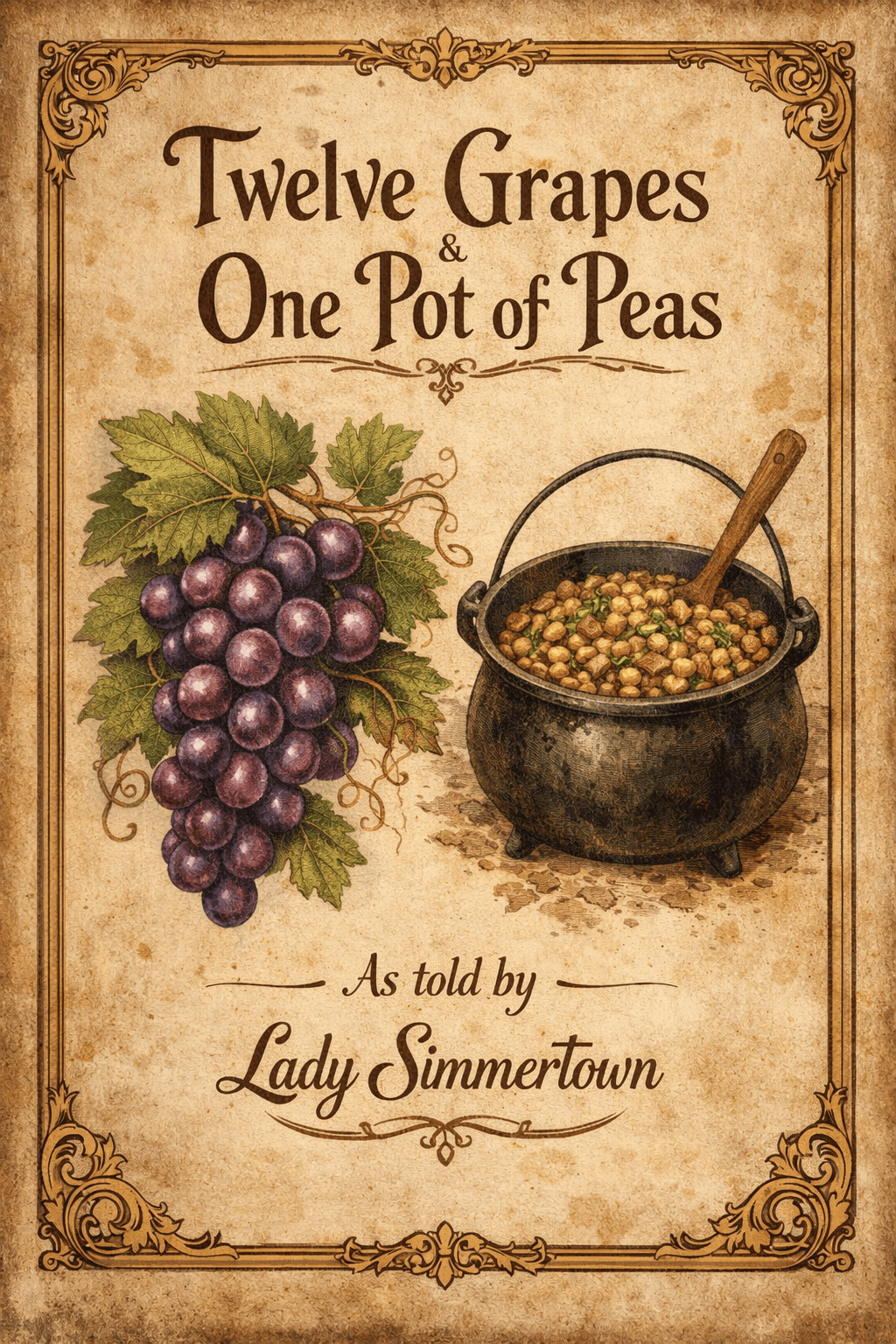
The tradition of eating twelve grapes at midnight arrives most directly from Spain, where each grape represents one month of the coming year. The ritual is precise and unforgiving. One grape per chime. Fall behind, and luck itself is said to stumble.
Though often framed as ancient, the custom as we know it took hold in the late nineteenth and early twentieth centuries, when Spanish grape growers, faced with an abundant harvest, encouraged the practice as a charm for prosperity. What began as clever marketing settled, over time, into something far more durable.
As Spanish customs traveled, particularly through Mexico, the grapes followed quietly. At our table, the grapes were familiar long before we ever questioned why.
They were eaten quickly, with laughter and urgency, the clock looming like a stern overseer. It was never elegant. It was never silent. And it never failed to feel important.
Black-Eyed Peas and the Alchemy of Survival
Black-eyed peas arrive at the New Year from an entirely different road.
Their story begins in West Africa, where they were cultivated long before they crossed the Atlantic through forced migration. In the American South, the peas were grown because they endured, nutritious, resilient, and reliable, carried forward by Black families in the aftermath of enslavement.
During the Civil War and Reconstruction, black-eyed peas became a food of survival. Union troops often dismissed them as animal feed and left them behind. Southern families, Black families in particular, relied on them when little else remained.
Over time, necessity softened into symbolism. The peas came to represent coins, modest prosperity, and the hope of a better year ahead. What once kept people alive was later rebranded as luck.
By the nineteenth century, eating black-eyed peas on New Year’s Day was no longer merely practical. It was aspirational.
Shared Symbols, Different Bowls
Across the Atlantic, other cultures carried similar hopes into the New Year using different foods. In parts of Europe, lentils symbolized prosperity because of their coin-like shape, often served alongside pork to signify abundance and continuity.
Though our table held peas rather than lentils, the meaning aligned effortlessly. Different legume. Same wish.
This is how food traditions behave when they travel. They do not argue. They adapt.
Mexico, Texas, and a Table That Asked No Questions
Mexico preserved Spanish customs through faith, family, and repetition. Texas, meanwhile, became a meeting place, of Mexico and the American South, of Indigenous resilience and European inheritance, of survival foods and celebratory ones.
By the time my family gathered around a New Year’s table in Texas, no one announced which tradition belonged where.
The grapes were simply there.
The peas were simply expected.
They sat beside one another, already blended by generations of movement and memory.
What This Table Was Truly Saying
This was not a confused tradition. It was a complete one.
It spoke of migration without maps. Of survival without footnotes. Of hope expressed through whatever ingredients were close at hand.
To eat this way was to participate in history without knowing it.
To pass it down was to preserve it without trying.
Only later does one realize how much had been carried forward, quietly, faithfully, year after year.
At the Turning of the Year
If luck exists at all, perhaps it does not reside in grapes or peas, but in the act of remembering where our food comes from, and who carried it forward.
At midnight, when the grapes were counted and the peas passed from pot to bowl, we were not performing separate rituals. We were continuing a conversation centuries in the making.
And that, dear readers, feels like a very good way to begin a year.
Yours, with history on the stove and hope at the table,
~Lady Simmertown
FOR THE SKEPTICS & SCHOLARS
- Albala, Ken. Food in Early Modern Europe. Greenwood Press.
- Pilcher, Jeffrey M. Planet Taco: A Global History of Mexican Food. Oxford University Press.
- Twitty, Michael W. The Cooking Gene. Amistad.
- Davidson, Alan. The Oxford Companion to Food. Oxford University Press.
- Smithsonian National Museum of African American History & Culture – Black-Eyed Peas & Hoppin’ John
- Instituto Cervantes – Las doce uvas de la suerte
- Library of Congress – African foodways in the American South




 Butter, Ink & Indiscretion
Leave a comment