
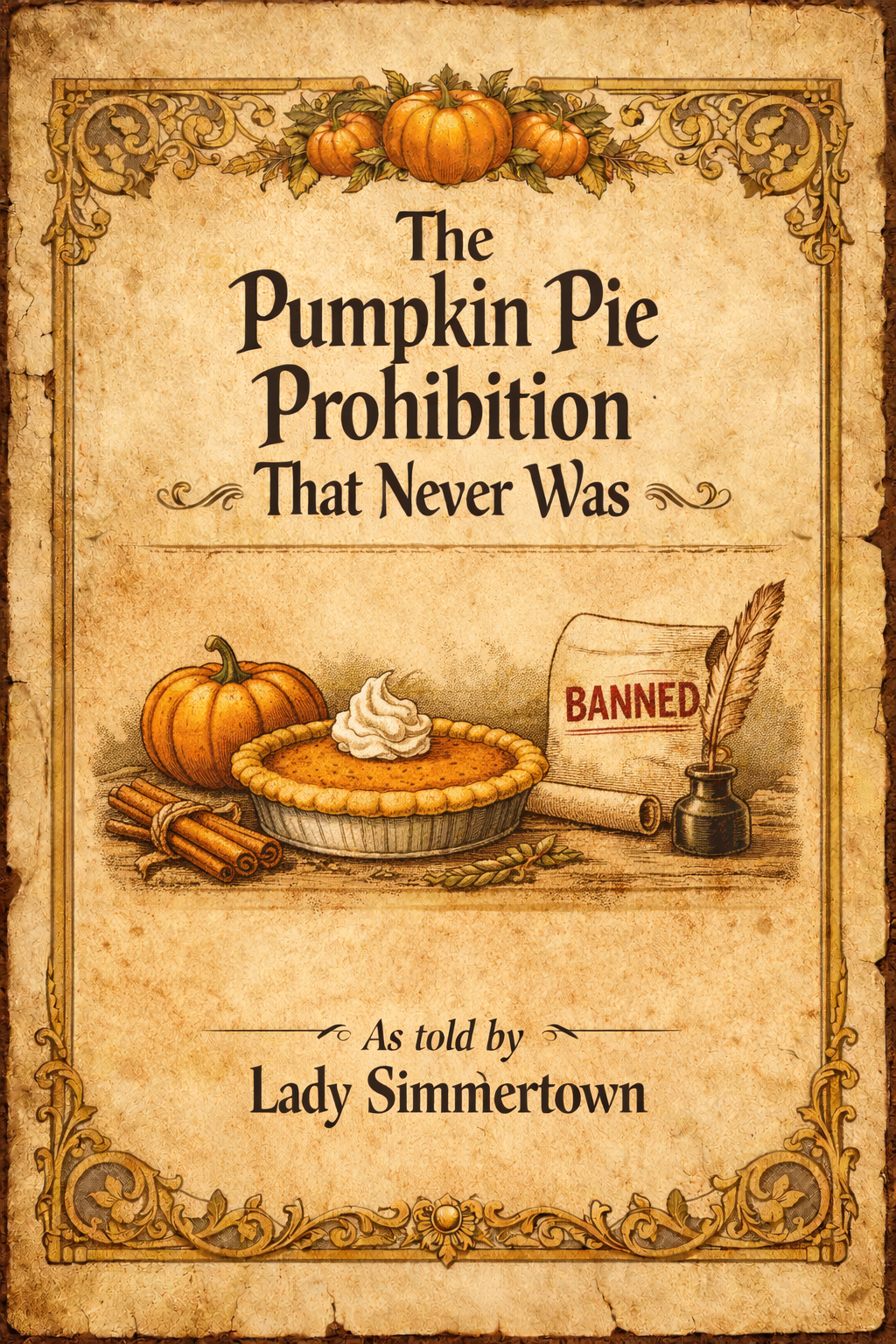
A Scandal of Puritans, Pleasure, and the Pastry They Feared to Name…
Dearest Readers,
Summon your most delicate fan, for what I am about to reveal may cause even the stoutest hostess to gasp over her teacup. There exists a rumor, passed from kitchen to kitchen, that the pumpkin pie was once banned in early America. Imagine it. A crime of crust. A pastry outlawed for its seductive scent of sugar and spice. A moral panic over custard.
It is a delicious rumor, but not a truthful one.
Yet do not fret. The truth is far more telling. No law ever pronounced pumpkin pie forbidden. Instead, the Puritans of seventeenth century Massachusetts passed a far broader decree. In 1659, the General Court declared it unlawful to celebrate Christmas with feasting, rest, or merriment. They sought to strangle pleasure at its root. They believed jubilation was sin in silk stockings. They feared joy.
And where joy is forbidden, pie cannot thrive.
Puritans, Pleasure, and the Terror of Spice
The earliest Thanksgivings in New England were not feasts at all. They were days of prayer, trembling humility, and sermons that warned against indulgence. The table was plain. Food was eaten without display. There were no crusts, no scented pies, no bright orange custards. Not because they were banned, but because they were unthinkable.
Spices were viewed with suspicion. Sugar was wasteful. Butter was vanity. To take pleasure in what one ate was considered spiritually risky. Puritan leaders believed the tongue could betray the soul. They did not trust food that tasted too good.
Let us be clear. The pumpkin was present. Pumpkins grew everywhere. Indigenous communities had cultivated them long before a single Puritan stepped off a ship. But the pie was not yet born. Not at the 1621 harvest feast. Not in that century at all.
There was no crust. There was no oven suitable for its making. There was not even enough sugar to sweeten such a dish. The pie would have to wait.
A Pie That Arrived Late and Rose Gloriously
More than one hundred years passed before pumpkin pie emerged in its recognizable form. The world changed. Sugar flowed more easily across the Atlantic. Spice ships sailed their long, fragrant journeys. Brick ovens became common. And at last, in 1796, the first true American cookbook appeared. Written by Amelia Simmons, it bore the beautiful title American Cookery.
Within it, a recipe for pumpkin pudding baked in a crust. The pompkin pie was born.
No Puritan thundered against it. No priest denounced it. No law forbade its presence. But if the sour spirits of 1659 had still been alive, I have no doubt they would have fainted at the sight of such luxurious defiance.
The True Scandal of the Pie
And so, my dear readers, we arrive at the real scandal.
Pumpkin pie became the great symbol of American Thanksgiving not because it was always present, but because it had once been unimaginable. It represents not the frozen solemnity of early New England, but the sensual, spiced celebration that came later.
It rose from a culture that finally permitted itself pleasure. It is a triumph of sweetness over severity. A victory of spice over fear. It is proof that joy has a way of slipping in, even through cracks in brick and doctrine.
So the next time you lift your fork toward that velvet orange filling, remember this.
You are not eating something that was outlawed.
You are eating something that once could not exist.
And that, I assure you, is far more delicious.
Forever your correspondent in edible intrigue,
Lady Simmertown
For the Skeptics and the Scholars
Records of the Massachusetts General Court, 1659, fining Christmas feasting
Amelia Simmons, American Cookery, 1796, featuring one of the first true pumpkin pie recipes
Early colonial foodways documented by Historic New England
Tristram Potter Coffin, The Book of Thanksgiving
Kathleen Curtin, Giving Thanks: Thanksgiving Recipes and History
Stavely and Fitzgerald, America’s Founding Food
Primary historical accounts of the 1621 feast, which do not mention pie